Gradia Militaria
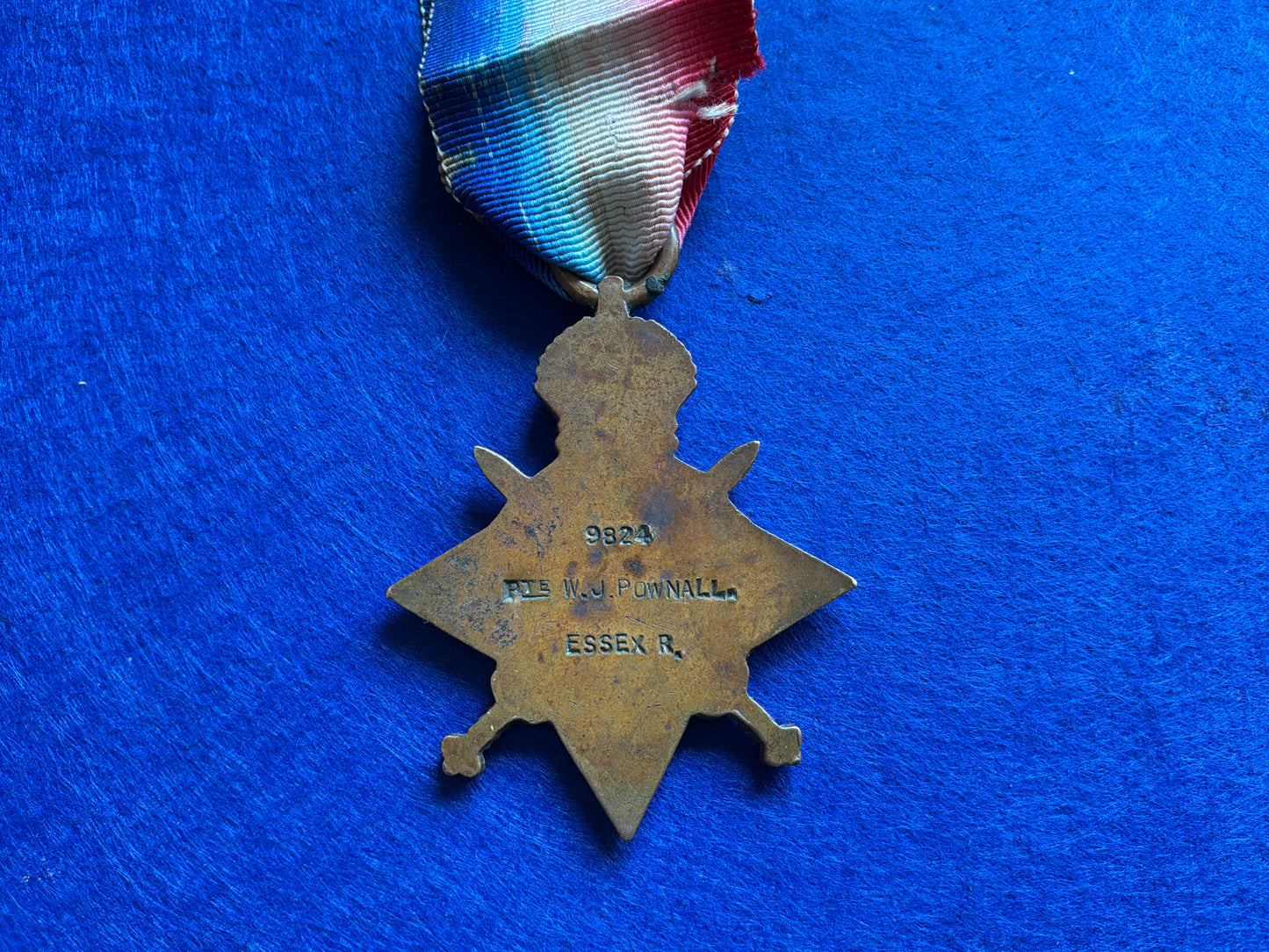
1914-15 Star; 1st day lander Gallipoli, W.J.POWNALL, 1st Bn Essex Regt (W.I.A)
1914-15 Star; 1st day lander Gallipoli, W.J.POWNALL, 1st Bn Essex Regt (W.I.A)
SKU:May26-107
Couldn't load pickup availability
REGULAR SOLDIER
William John Pownall was a pre-war regular soldier, not a wartime volunteer. His service record reveals a man already well-seasoned by the time the Great War began. His regimental number, 9824, identifies him as an established member of the regular army, and his record of service shows he had been posted across the British Empire in the years before 1914, serving in India and then Mauritius before returning home. When war was declared, he came back to England with the 1st Battalion of the Essex Regiment, which had been garrisoned in South Africa and Mauritius.
THE 29TH DIVISION AND THE ROAD TO GALLIPOLI
On returning to England in December 1914, the 1st Essex were absorbed into the newly formed 29th Division, a formation assembled from regular battalions recalled from garrisons across the Empire. The division would earn the nickname "The Incomparable Division" for its conduct at Gallipoli. Pownall moved with his battalion to Banbury in January 1915, and on 21st March 1915 they sailed from Avonmouth, bound for the Eastern Mediterranean via Egypt and the island of Mudros.
25TH APRIL 1915: THE FIRST DAY AT CAPE HELLES
Private Pownall's Medal Index Card records his theatre of war entry date as 25th April 1915 in the Balkans theatre (the official designation for the Gallipoli campaign). This makes him a confirmed first day lander at Cape Helles, one of a relatively small number of men who can be placed on the peninsula from the very opening hours of the campaign.
The 1st Essex, as part of 88th Brigade, were originally scheduled to land at V Beach. However, the catastrophic losses suffered by the Dublin Fusiliers attempting to storm ashore from the converted collier River Clyde forced a rapid change of plan. The battalion was diverted to W Beach, where W Company landed at 8.30am, storming the cliffs to the right of the Lancashire Fusiliers who had just won six Victoria Crosses in their own desperate assault. The fighting that day was savage, the beaches swept by Turkish machine gun and rifle fire, and casualties across the division were enormous.
Pownall's service record confirms that he was among the casualties of that first day. He sustained a gunshot wound to the buttock on 25th April 1915, wounded in the very act of landing or in the immediate fighting that followed. That he recovered and continued to serve through the remainder of the Gallipoli campaign, and subsequently in Egypt, speaks to considerable resilience.
THE GALLIPOLI CAMPAIGN, APRIL TO DECEMBER 1915
Pownall remained on the Gallipoli peninsula from the day of the landing until January 1916, a period of approximately nine months. The 1st Essex fought through some of the campaign's most punishing engagements, including the three Battles of Krithia and the Battle of Gully Ravine. By August 1915, during an offensive on 5th August, the battalion suffered 50 men killed, 202 wounded, and 180 missing in a single day's fighting. The attrition throughout the campaign was relentless. Pownall was among those who endured it from the very first day to the final evacuation.
The 1st Battalion was evacuated from Gallipoli on 8th January 1916 and moved to Egypt to regroup.
EGYPT AND A PENSION CLAIM
Pownall's pension records, which survive at the National Archives, reveal that he returned to active service in Egypt from 18th March 1917. It was here, on 26th November 1917, that he sustained the injury which would form the basis of his pension claim: a fall into a trench caused synovitis and wasting of the muscles of both legs. He was assessed by a medical board at grade B III and treated at the 17th General Hospital in Alexandria and the 71st General Hospital at Helwan.
His pension record also notes a discharge under Section B on 24th June 1919, confirming that William John Pownall survived the war. His total recorded service amounted to 4 years and 241 days.
THE MEDAL
The 1914-15 Star was awarded to all those who served in an operational theatre between 5th August 1914 and 31st December 1915. For Pownall, the qualification date was the most significant possible: 25th April 1915, the opening day of the Gallipoli landings. The reverse of the medal is impressed in the standard manner: 9824 Pte W.J. Pownall. Essex R. The original ribbon survives with the medal. He was additionally awarded the British War Medal and the Victory Medal, the trio together known informally as Pip, Squeak and Wilfred.
His service record is an unusually complete survival. Many such records were destroyed in the Blitz in 1940. That his pension file endured allows us to reconstruct not only where he served, but the physical cost the war exacted on him long after the beaches of Cape Helles had fallen silent.
Share