Gradia Militaria
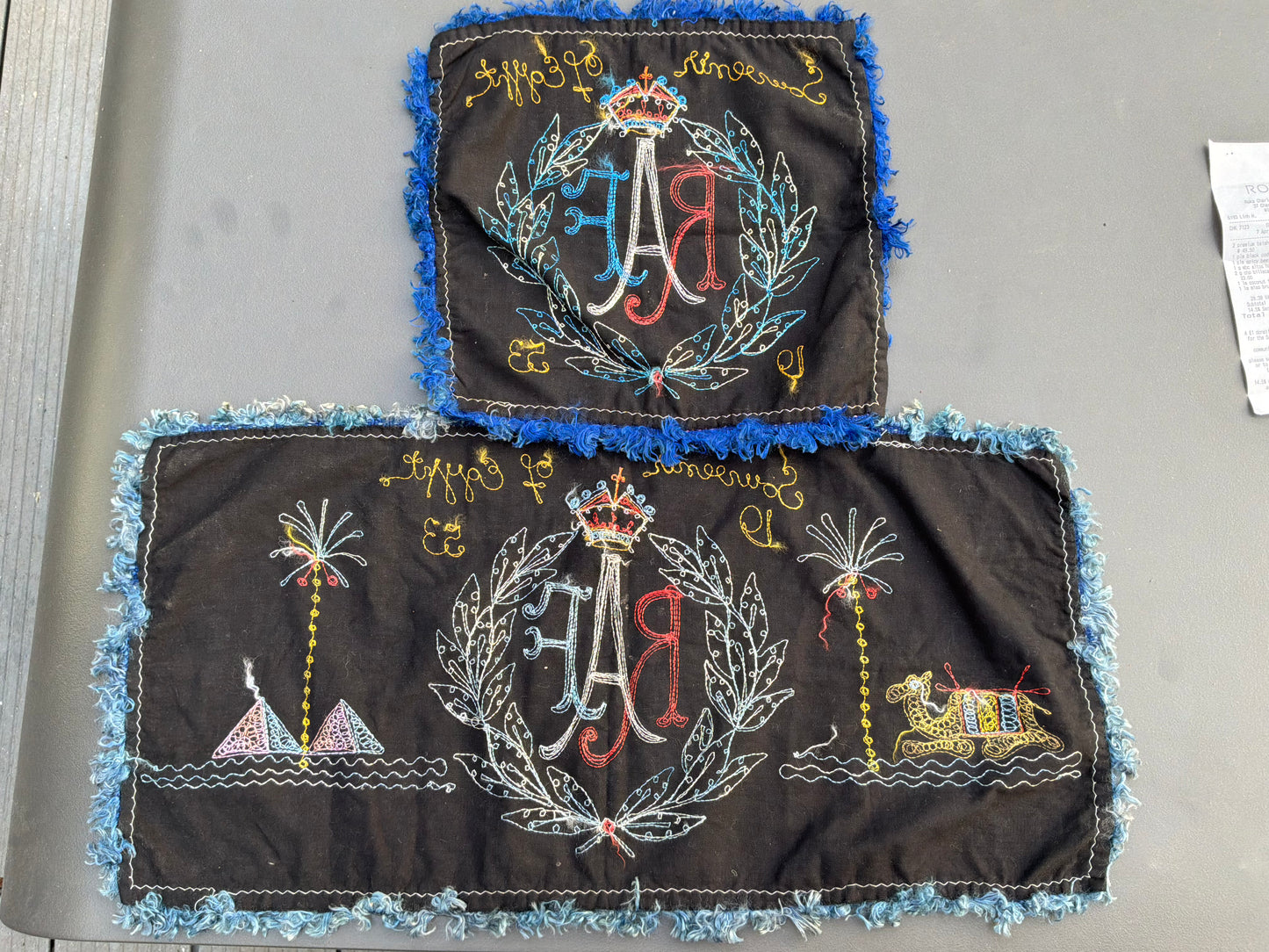
Egyptian bazaar R.A.F souvenir silk textiles, circa 1953
Egyptian bazaar R.A.F souvenir silk textiles, circa 1953
SKU:MAY26-007
Couldn't load pickup availability
These are a matched pair of Egyptian bazaar souvenir textiles – a cushion cover and a table runner – made specifically for British servicemen to buy and send home. The rectangular runner format edged with blue tassels and embroidered with a service corps badge, with a camel scene to one side and pyramids to the other, was a standard design that Egyptian bazaar makers adapted endlessly for different regiments and services. These two pieces follow that exact template, with the RAF cypher and crown at the centre, palms and camel to the left, pyramids to the right, and “Souvenir of Egypt 1953” above.
The men who bought them
By 1953 the RAF had a substantial presence in the Canal Zone. Between 1945 and 1956, British servicemen garrisoned bases on the Suez Canal in Egypt, and by 1954 the garrison numbered 70,000 troops. The main RAF stations in 1953 included Fayid, Kabrit, Deversoir, and Abyad – all in the Canal Zone along the Great Bitter Lake. National Servicemen made up a large proportion of the RAF personnel there; young men of 18 to 20, many of whom had never been abroad before, suddenly finding themselves in the heat and dust of the Egyptian desert.
These embroideries were popular in part for their vibrant colours and the ease with which they could be folded and sent home. A young airman could buy them cheaply in the bazaar – or from the endless stream of Egyptian traders who worked around the camp perimeters – roll them up, and post them home to his mother or girlfriend in a cardboard tube or a flat parcel.
The situation in Egypt in 1953
1953 was a particularly tense year to be serving there. Between 1950 and 1956, violence escalated: 54 servicemen were killed and many others injured. In October 1951, the Egyptian government had repealed the 1936 treaty, and Egyptian nationalists began actively targeting British personnel and installations. On 23 July 1952 a military coup by Egyptian nationalist officers overthrew King Farouk, and the Revolutionary Command Council, which replaced him, intensified Egyptian demands to take control of the Suez Canal. So the young airmen buying these cheerful souvenirs in 1953 were doing so in an atmosphere of genuine danger – living conditions were harsh, with most men in tents or partially hutted camps, dealing with disease, extreme heat, and the constant threat of attack.
From October 1951, guerrillas killed nearly 60 British servicemen in the Canal Zone, and Egyptians working for the British were also targeted and stopped from working on military camps. The bazaar souvenir trade was one of the few relatively normal points of contact between British servicemen and the Egyptian civilian population during this difficult period.
The tradition
This type of souvenir had a long lineage. Souvenir embroideries were produced in Egypt, Syria, and Palestine in both World Wars, and the experience of bartering and bargaining in the Musqi – Cairo’s 500-year-old bazaar district – has been recounted by veterans across multiple generations. The same stalls that sold WW1 Tommies their cushion covers in 1916, and WW2 soldiers theirs in 1941, were still selling to National Servicemen in 1953. The designs barely changed across forty years – black velvet, blue fringe, camel, pyramids, palms, and whatever badge the customer belonged to.
The 1953 date is particularly poignant. In October 1954, Britain and Egypt concluded the Anglo-Egyptian Agreement on the phased evacuation of British Armed Forces from the Suez base. The men who bought these in 1953 were among the last generation of British servicemen to buy Egyptian bazaar souvenirs as a routine part of their service life in Egypt. Within a year the withdrawal was agreed; within three years came Suez, and the whole era closed.
Share