Gradia Militaria
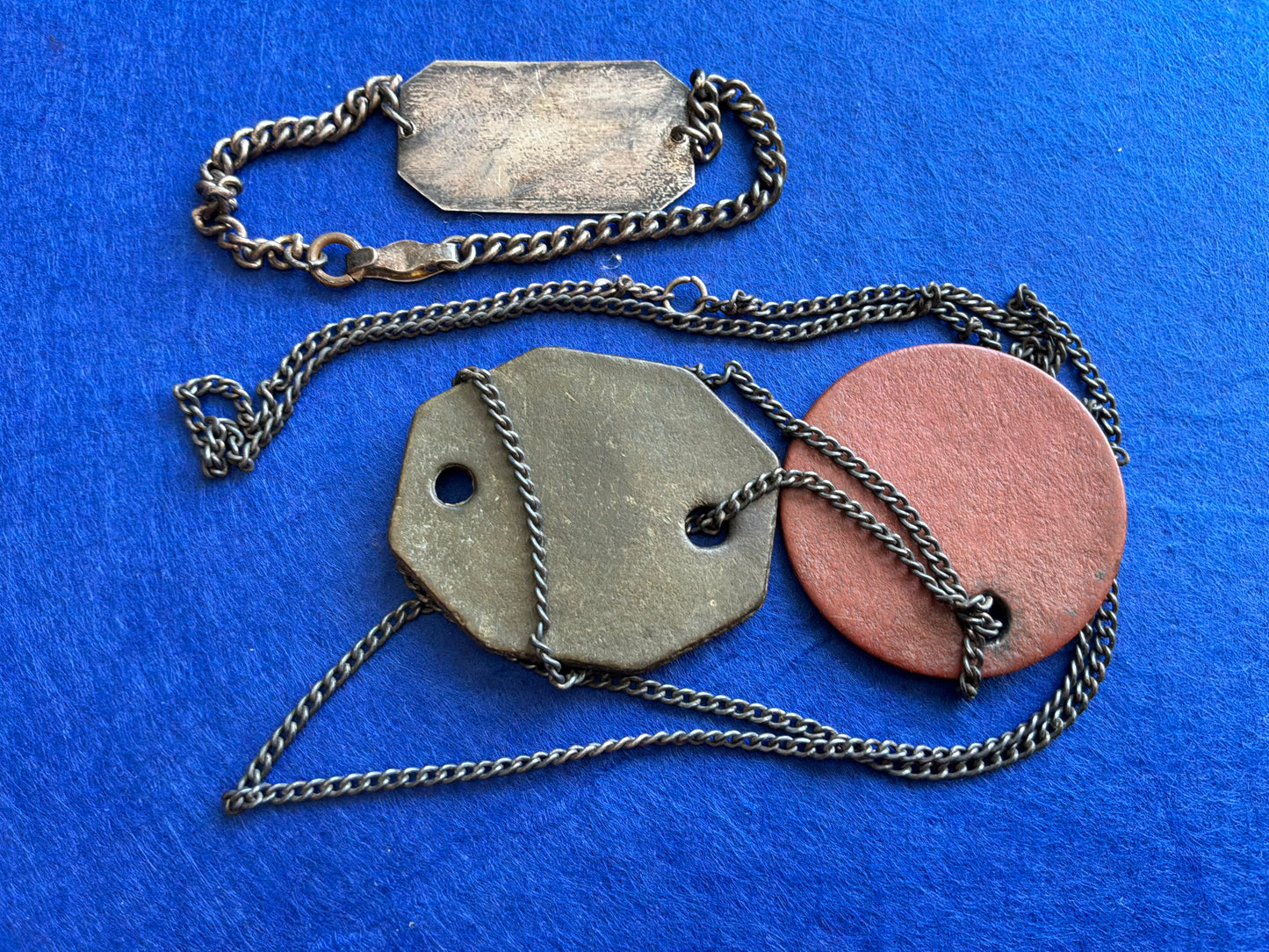
Identity disc set, Captain T.A.A GARNER 1/4th Dorset Regiment
Identity disc set, Captain T.A.A GARNER 1/4th Dorset Regiment
SKU:June26-14
Couldn't load pickup availability
Thomas Alfred Arthur Garner
1st/4th Battalion, Dorsetshire Regiment (Territorial Force)
Army Number: 100441
The three-piece identity set belonging to Captain Thomas Alfred Arthur Garner – comprising a silver identity bracelet and two British Army issue fibre identity discs – provides a compelling personal link to one of the lesser-known theatres of the First World War: the Mesopotamian Campaign on the Euphrates Front.
The Identity Tags
The set consists of a silver officer’s identity bracelet, hand-engraved “Capt. T.A.A. Garner / 100441 / ” Together they form a complete and rare survival: the silver bracelet is a private purchase, almost certainly commissioned by the officer himself or presented as a gift, while the two fibre discs are the regulation War Office issue worn around the neck.
The Regiment and Its War
Captain Garner served with the 1st/4th Battalion, Dorsetshire Regiment, a Territorial Force unit that had a distinctly different war from the majority of British infantry battalions. While the Western Front dominates popular memory of the Great War, the 1/4th Dorsets served entirely in the Middle East.
Men who volunteered to serve overseas joined the 1/4th and sailed in October for India, where they relieved a Regular Army battalion. After service and rigorous training in India, the 1/4th landed at Basra in late February 1916 as part of the 15th Indian Division.
From Basra, at the end of April 1916 they began a gruelling twelve-day march to Nasiriyeh, where they became part of the 15th Indian Division. The battalion would serve for the remainder of the war on the Euphrates Front of the Mesopotamian Campaign. Within the 15th Indian Division, the 1/4th Dorsets formed part of the 42nd Indian Brigade, together with the 1/4th Battalion, Devonshire Regiment, the 1/5th and 2/5th Gurkha Rifles (Frontier Force), and the 2/6th Gurkha Rifles.
The 15th Indian Division was formed on 7 May 1916 on the Euphrates Front and took part in the following named actions: the Action of As Sahilan in September 1916, the Capture of Ramadi in September 1917, the Occupation of Hit in March 1918, and the Action of Khan Baghdadi in March 1918.
In late September 1917, the 1/4th Dorsets played a decisive part in the Battle of Ramadi on the Euphrates, capturing with two Gurkha battalions the ridge that dominated the Turkish position. The battalion’s part in this success was specifically mentioned in the official despatch. Six months later, on 23rd March 1918, the Dorsets played a leading part in capturing Khan Baghdadi, where 5,000 Turks were taken prisoner.
This was demanding, grinding warfare in extreme heat, across desert terrain utterly unlike the mud of Flanders – and in a theatre that received far less recognition, then and since, than the Western Front.
Captain Garner’s Survival and Later Service
Captain Thomas Alfred Arthur Garner survived the Mesopotamia campaign, returning to England after the armistice. That he was recorded again in 1939 as an officer in British Army service speaks to a man who retained his military connection through the interwar period, whether through the Territorial Army or some other capacity.
By 1939, he was living at “Fairlawn,” Priory Avenue, Hoe Street, Walthamstow, London E17.
His reappearance in Army records in 1939 suggests he was among those Territorial officers who were recalled or re-engaged as war threatened again – men whose Great War experience made them valuable assets to a rapidly expanding Army even two decades on.
Researching Further
Share