Gradia Militaria
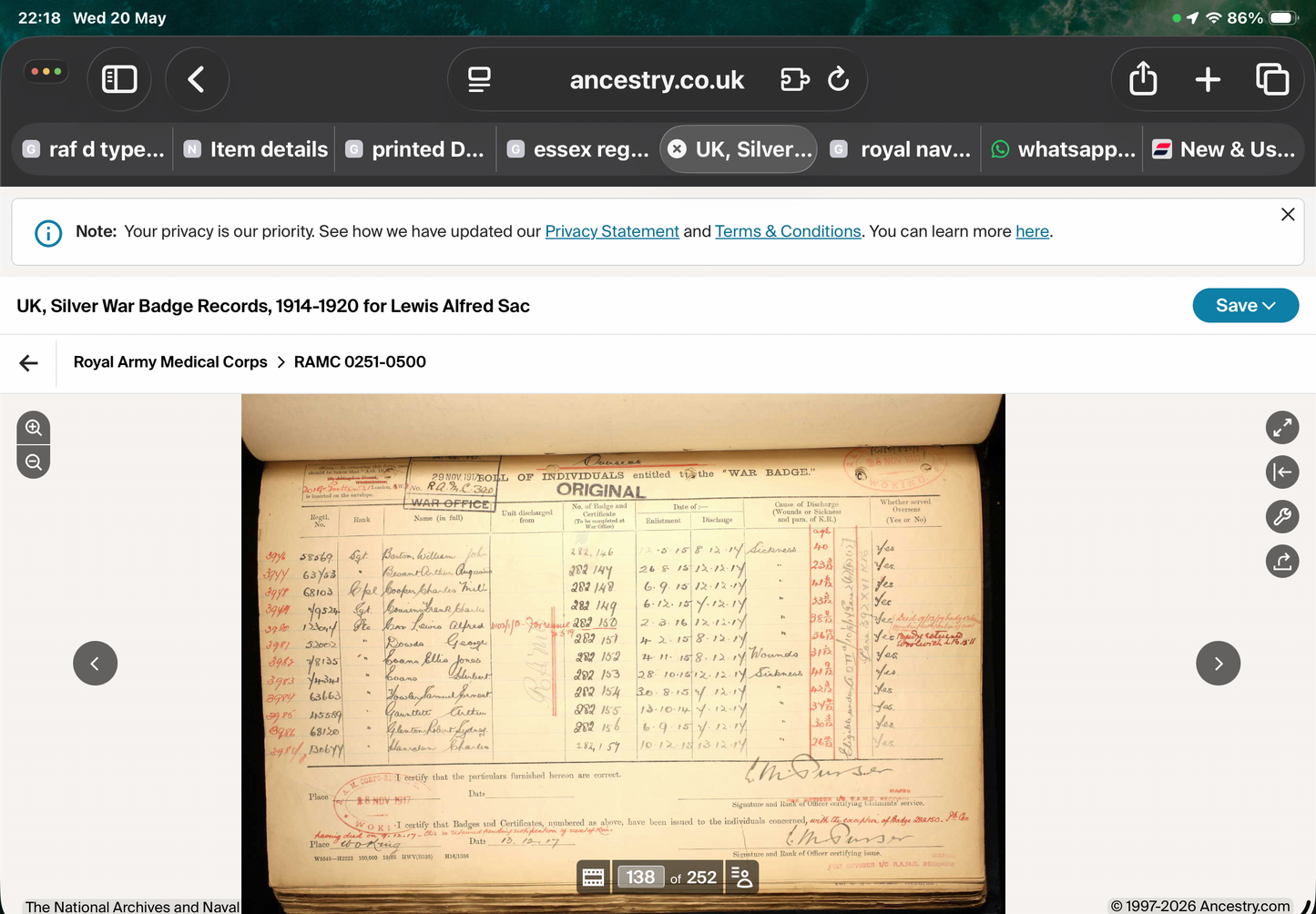
S.W.B 282150,issued twice, first to Pte SAC R.A.M.C then Lieut Antram A.O.C
S.W.B 282150,issued twice, first to Pte SAC R.A.M.C then Lieut Antram A.O.C
SKU:May26-110
Couldn't load pickup availability
A Badge with Two Owners: The Remarkable Story of Silver War Badge No. 282150
The First Man: Private Lewis Alfred Sac, RAMC
The records held at The National Archives (series WO 329) show that badge number 282150 was first assigned to Private Lewis Alfred Sac, army number 123044, of the Royal Army Medical Corps. He had enlisted on 4 February 1915 and served through much of the war, his discharge recorded as due to sickness. The RAMC roll (piece RAMC 0251-0500) shows his entry alongside those of fellow soldiers discharged around the same period, with badge number 282150 allocated to him in the normal course of War Office administration.
However, a note recorded against his entry tells a sombre story: Private Sac died before he was able to receive his badge. Crucially, the Silver War Badge could not be claimed or awarded posthumously – the total of posthumous awards is recorded as zero. With the badge already allocated and numbered, but its intended recipient now dead, the War Office faced an administrative decision. Rather than retire the number, badge 282150 was reissued.
The Second Man: Lieutenant E. A. Antram, Royal Army Ordnance Corps
The badge found its second and final recipient in Lieutenant E. A. Antram of the Royal Army Ordnance Corps. The War Office approval list (piece 3251, WO 329), dated 1 July 1919, records his name alongside fellow officers, with badge number 282150 assigned to him, and his address given as Wanwood, Milford, Surrey. The Ancestry record for E. A. Antram confirms the details: rank of Lieutenant, Regiment listed as Army Ordnance Corps, Discharge Regiment as Royal Army Ordnance Corps, and badge number 282150 – military year 1920.
Lieutenant Antram had therefore received a badge that already had a prior history – one that had been allocated to a soldier of an entirely different corps, who had served in very different conditions, and who had not survived to wear it.
Reissued badge numbers are genuinely unusual. Each badge was uniquely numbered on the reverse, and the War Office maintained registers recording the soldier to whom each badge number was issued. The system was designed for one badge, one man. When a badge number appears against two different names in the rolls, it is a sign that something out of the ordinary occurred in the administrative process – most commonly, as here, the death of the first recipient before delivery could be made.
Badge 282150 is therefore a tangible link between two very different men: a private soldier of the RAMC who served through the war but did not live to receive his recognition, and the officer of the Royal Army Ordnance Corps who ultimately wore it.
Share