Gradia Militaria
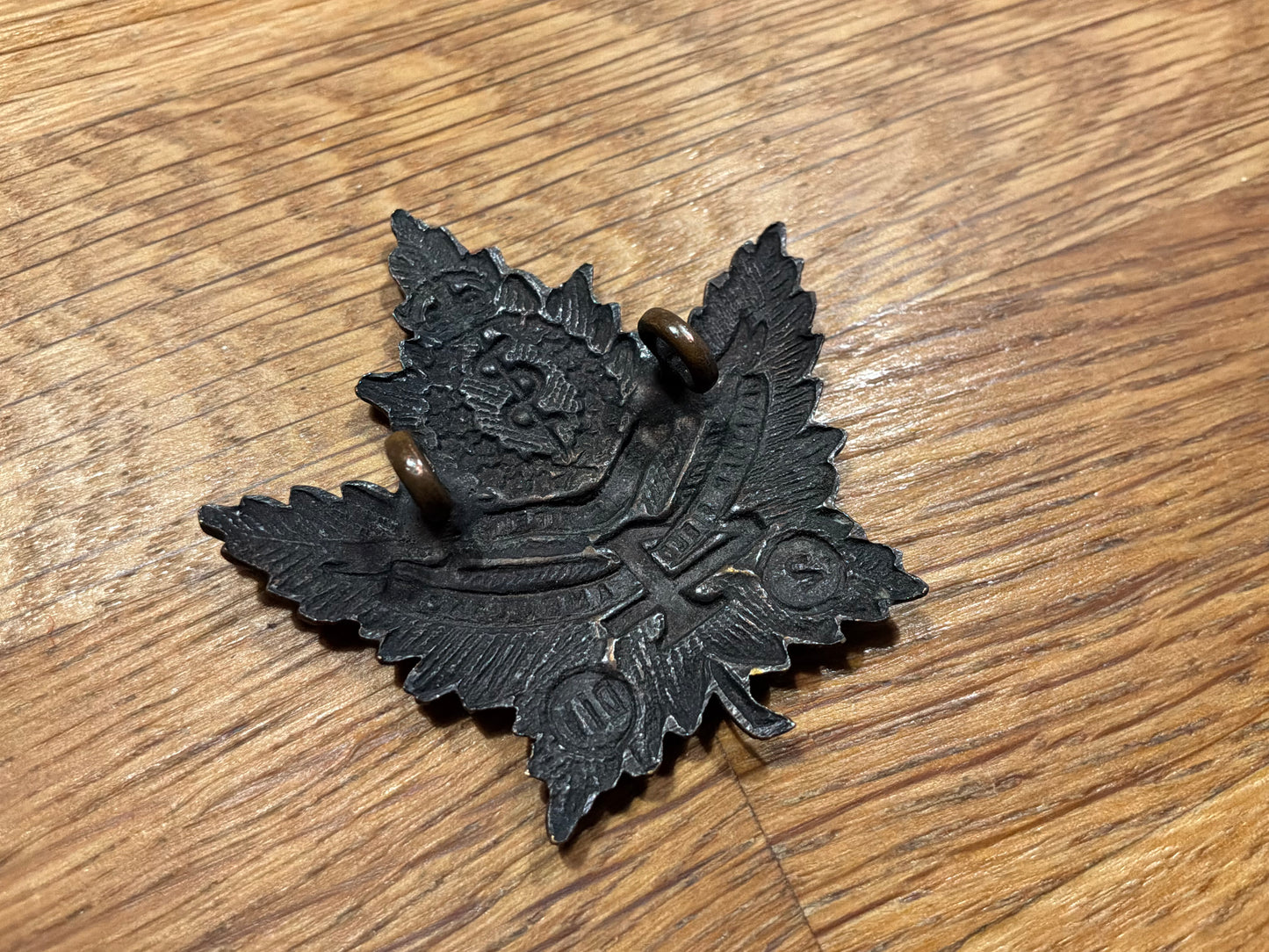
WW1 CEF 4th Canadian Field Ambulance cap badge.
WW1 CEF 4th Canadian Field Ambulance cap badge.
SKU:June26-72
Couldn't load pickup availability
4th Canadian Field Ambulance — WWI Maple Leaf Cap Badge
A handsome blackened brass maple leaf badge of the 4th Canadian Field Ambulance, Canadian Army Medical Corps (CAMC), Canadian Expeditionary Force. The central design carries the Rod of Asclepius beneath the King’s Crown within a wreath, with the CAMC motto “In Arduis Fidelis” (faithful in adversity) on the ribbon above. Below, the unit scroll reads “CANADIAN FIELD AMBULANCE” with the divisional designation “2 DIV” flanking the lower limbs of the cross. The reverse retains both original copper lugs intact.
The unit
The 4 Canadian Field Ambulance was formed in Winnipeg on 7 November 1914 and served in France and Flanders 1915 to 1919 as part of the 2nd Canadian Division. The unit was authorised under General Order 36 of 3 March 1915 alongside its sister 5th and 6th Field Ambulances, which together made up the medical backbone of the 2nd Division.
The 4th, 5th and 6th Field Ambulances were drawn from across the country and embarked for England in April 1915, sailing on to France in September of that year. From that point until the Armistice, the 4th CFA followed the 2nd Canadian Division through every major engagement of the Canadian Corps on the Western Front.
WWI service
The 2nd Canadian Division, and with it the 4th Field Ambulance, took part in the great battles that defined the Canadian Corps:
∙ Mount Sorrel and St. Eloi (1916) — the division’s bitter introduction to trench warfare in the Ypres Salient.
∙ The Somme (1916) — Flers-Courcelette, Thiepval, Ancre Heights. The Field Ambulance ran Advanced Dressing Stations and stretcher-bearer relays under continuous shellfire.
∙ Vimy Ridge (April 1917) — the celebrated Canadian Corps victory. The 4th CFA worked alongside the 5th and 6th, evacuating wounded across the captured ridge in the days following 9 April.
∙ Hill 70 and Lens (August 1917) — three divisions, the 1st, 2nd and 4th, were engaged.
∙ Passchendaele (October to November 1917) — fighting in the worst mud conditions of the war, with stretcher-bearer parties needing six to eight men to carry a single casualty.
∙ The Hundred Days (August to November 1918) — Amiens, the Drocourt-Quéant Line, Canal du Nord, Cambrai, and the Pursuit to Mons.
Field Ambulance work was dangerous and exhausting. The unit operated the system of forward Regimental Aid Posts, Advanced Dressing Stations and Main Dressing Stations that fed casualties back to the Casualty Clearing Stations behind the line. Stretcher-bearers worked under direct fire, and the CAMC suffered heavy losses across the war. The 4th CFA was disbanded under General Order 211 of 15 November 1920, and its lineage is perpetuated today by 18 Field Ambulance, Thunder Bay.
Share