Gradia Militaria
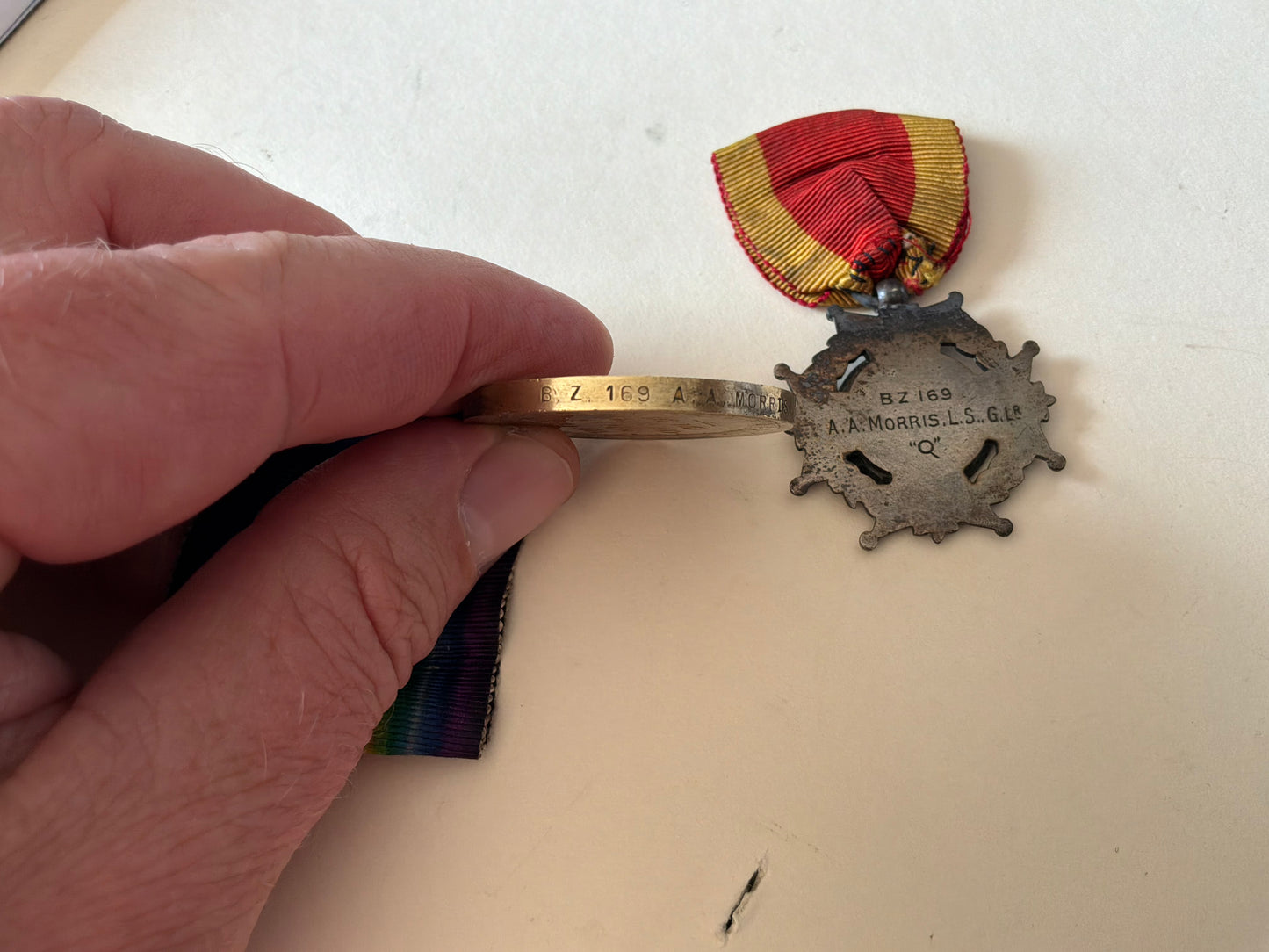
Victory & Unknown medal, B.Z 169 A.A.MORRIS L.S RNVR
Victory & Unknown medal, B.Z 169 A.A.MORRIS L.S RNVR
SKU:MAY26-006
Couldn't load pickup availability
Albert Arthur Morris — A Bristol Sailor's War, 1914–1919
| Full name | Albert Arthur Morris |
| Service number | BZ 169 — Bristol Division, RNVR |
| Rank | Acting Leading Seaman |
| Qualification | G.L.R. — Gun Layer, Reserve |
| Enlisted | 19 December 1914 |
| Ships served | Royal Naval Division · HMS Victory I · HMS Agincourt · HMS Reclaim · HMS President III |
| Special service | "Q" — Q-ship duty |
| Award | King's Certificate No. 6740, issued 25 September 1919 |
On 19 December 1914, four months into the First World War, Albert Arthur Morris from Bristol volunteered for the Royal Naval Volunteer Reserve — the 169th war-service volunteer from the Bristol Division. The RNVR, nicknamed the "Wavy Navy" for the wavy gold braid its officers wore, took in men from offices, workshops and streets, trained them, and put them to sea. Morris would serve across five years of war.
With the Royal Naval Division
Morris's first posting was to the Royal Naval Division, an unusual formation raised in 1914 when the Admiralty found itself with more trained men than ships. The RND fought as infantry, not sailors. Whether Morris deployed overseas or served in a shore capacity is not recorded, but the posting places him in one of the war's most distinctive formations from its very earliest months.
Aboard HMS Agincourt
By the middle years of the war, Morris had earned a gunnery qualification — his record and medal both carry the abbreviation G.L.R., Gun Layer, Reserve, a specialist rating that carried additional pay. HMS Agincourt was unlike any other warship in the Royal Navy: originally ordered by Brazil, sold to the Ottoman Empire, and seized by Britain in August 1914. She carried fourteen 12-inch guns in seven twin turrets — more than any other dreadnought ever built — and her crew nicknamed her the Gin Palace. Morris was assigned to Agincourt Section 7, one of her seven turrets, each named after a day of the week. On 21 November 1918, she was present at the surrender and internment of the German High Seas Fleet.
Special service — the Q-ships
The most intriguing entry on both Morris's service record and his mystery medal is a single letter in quotation marks: "Q". This almost certainly denotes service on a Q-ship — the Royal Navy's most secretive and most dangerous anti-submarine weapon of the war. Q-ships were merchant vessels in disguise, their concealed gun crews waiting for a U-boat to surface at close range before dropping their panels and opening fire. For a trained gun layer, the work was as demanding as it was dangerous.
The King's Certificate
Morris was discharged having been disabled in the war. He received King's Certificate No. 6740, issued 25 September 1919 — an ornate scroll bearing a facsimile signature of King George V, confirming that the recipient had served with honour and been disabled in the Great War. Each certificate was individually numbered and sent by registered post in a specially designed cardboard tube.
The mystery medal
This collection includes an unnamed cross-shaped medal on a red and gold ribbon, with a Portuguese Republic coin of 1915 set into its centre. On the reverse, in neat stamped lettering: BZ 169 / A.A. MORRIS. L.S. G.L.R / "Q". The medal does not correspond to any official Portuguese military decoration. It appears to be a privately made presentation piece — a genuine Portuguese coin mounted into a decorative cross frame, a practice common among sailors who acquired mementos in foreign ports. How Morris came by it cannot now be known, but someone thought it worth having engraved with his name, his number, his rating, and his "Q".
Together with his British War Medal and Victory Medal, it is what remains of a remarkable five-year naval career — from one of the first Bristol volunteers in December 1914, through the Grand Fleet, the Q-ship patrols, and the King's own recognition, to a quiet discharge in 1919.
Share