Gradia Militaria
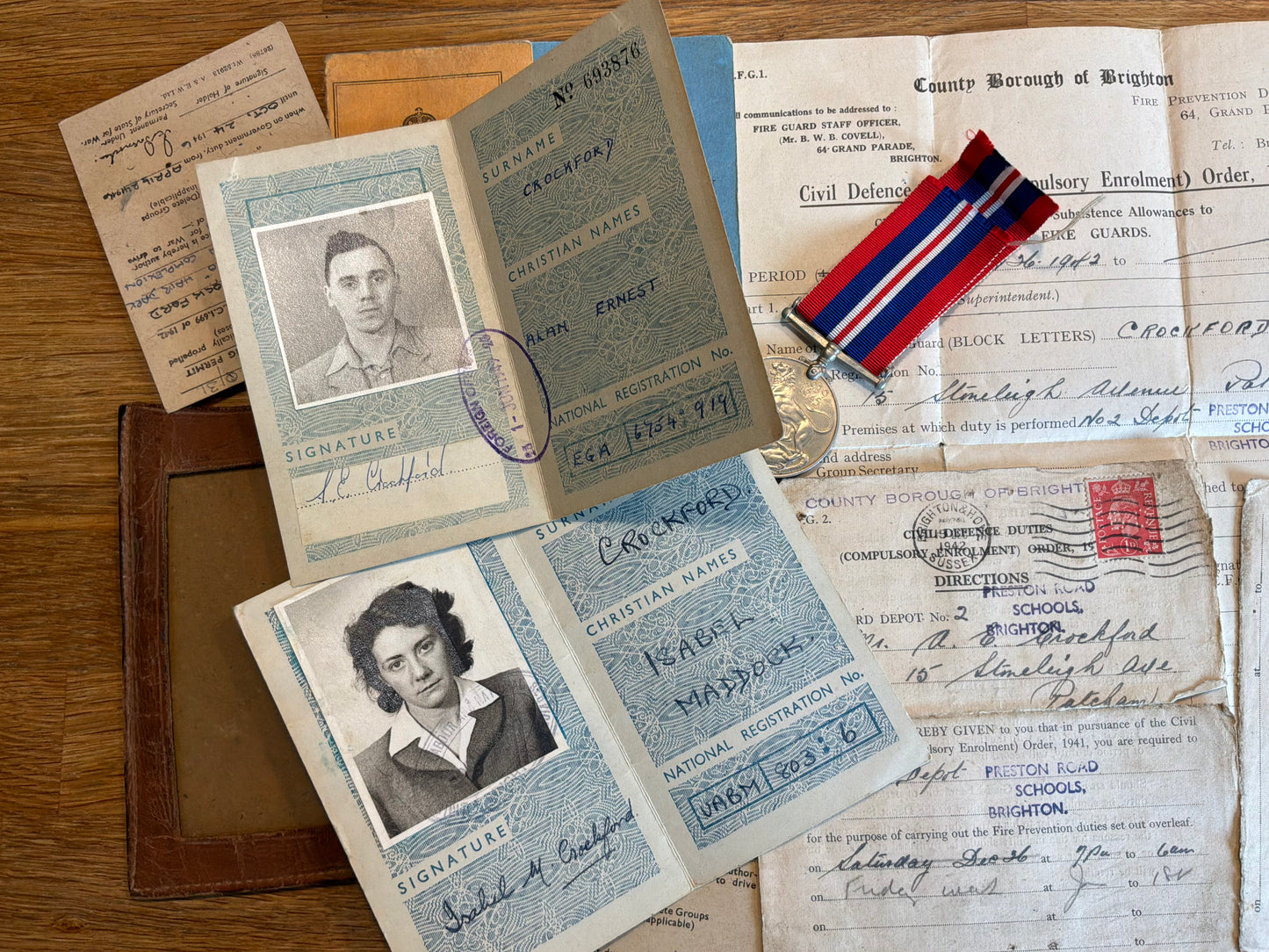
WW2 Brighton Home Defence/Wartime archive to Alan Crockford
WW2 Brighton Home Defence/Wartime archive to Alan Crockford
SKU:June26-08
Couldn't load pickup availability
Alan Ernest Crockford of Brighton: A Wartime Life
Alan Ernest Crockford was a Brighton man whose collection of surviving documents paints a vivid picture of civilian and military life during the Second World War and beyond. Living at 15 Stoneleigh Avenue, Patcham, on the northern edge of Brighton, Crockford appears to have been a practical, mechanically minded individual whose skills placed him at the intersection of civilian defence, military service, and peacetime public duty.
Civil Defence and the Home Front
Like thousands of ordinary Britons, Crockford found himself drawn into the machinery of civil defence well before he ever wore a uniform. A compulsory enrolment notice, issued by the County Borough of Brighton’s Fire Prevention Department at 64 Grand Parade, directed him to report to No. 2 Depot, Preston Road Schools, Brighton, to carry out fire prevention duties. The notice, dated December 1942, required him to attend on Saturday nights from 9pm to 6am and on Friday nights from a similar hour – long, cold shifts that would have been typical of the volunteer fire guard effort across Britain’s towns and cities during the Blitz and its aftermath.
His subsistence allowance claim form, also issued under the Civil Defence Duties (Compulsory Enrolment) Order 1942, covers a four-week period ending December 26 of that year. It confirms his name in block capitals as CROCKFORD A.E., his address as 15 Stoneleigh Avenue, Patcham, and his place of duty as Preston Road Schools. The Fire Guard Staff Officer responsible for the Brighton area was a Mr B.W.B. Covell, based at 64 Grand Parade. These documents capture a snapshot of organised local resilience – ordinary men and women standing watch over their neighbourhood through the darkest years of the war.
Military Service: 14th/20th King’s Hussars
As the war entered its final phase, Crockford was called into uniform. His War Department Driving Permit (Army Form A.2038, Serial No. 6297, marked “Provisional”) identifies him as Trooper 14988024 Crockford A.C., assigned to C Squadron, 57th Training Regiment, Royal Armoured Corps. The permit was valid from 18 September 1944 until 17 September 1945 – a service window of almost exactly one year, straddling the liberation of Western Europe and the final Allied victory.
The 57th Training Regiment RAC was a formation responsible for producing trained armoured crewmen, meaning Crockford would have been learning the skills of tank warfare at precisely the moment those skills were being put to their ultimate test on the Continent. His unit connection to the 14th/20th King’s Hussars – one of the British Army’s oldest and most distinguished cavalry regiments, by then operating as an armoured regiment – suggests he was being prepared to join or support that regiment’s operations.
Because he entered service so late in the conflict, Crockford was entitled to only one campaign award: the War Medal 1939-1945, the silver medal with its distinctive red, white and blue ribbon that is visible in the photographs. It was awarded to all who served at least 28 days in the armed forces between 3 September 1939 and 2 September 1945. Modest in number though his medals may be, the War Medal is an honest and fitting record of a man who answered his country’s call when it came.
A Man and His Machines
Running through Crockford’s entire wartime story is a clear thread: his love of and aptitude for vehicles and mechanical engineering. His earlier War Department Driving Permit (Serial No. HQ131), issued under the same A.C.I.699 of 1942, pre-dates his military enlistment and was valid from April 24 to October 24 of 1946, suggesting he was already operating in an official driving capacity. He is described as 5’10” with dark hair, brown eyes and a fresh complexion.
His Sussex Constabulary Driving Licence is particularly intriguing. The fact that he held a police-issued driving licence strongly suggests he was employed by the constabulary in a mechanical or transport capacity – most likely as a garage mechanic responsible for maintaining and repairing police vehicles. This was skilled and essential work; a police force during wartime and in the years of postwar austerity depended entirely on keeping its small fleet of vehicles roadworthy. The blue Driving Licence booklet bearing the name of Tivoli Garage, Tivoli Crescent, Brighton, points further in this direction – Tivoli Garage may well have been his employer or a workshop he was associated with.
The fact that his driving licences extend into the 1960s suggests Crockford lived well beyond the war years, carrying with him this collection of documents that chronicled the most dramatic chapter of his life.
Isabel Maddock Crockford
The collection also includes a Travel Identity Card for Isabel Maddock Crockford – almost certainly his wife – bearing her photograph and National Registration Number JABM 803·6.
Brighton’s Wartime Ordinary
What makes the Crockford archive so appealing is precisely its ordinariness. He was not a senior officer, not a decorated hero, not a man whose name appears in regimental histories. He was a Brighton man who watched for fires on winter nights, learned to drive military vehicles, served his year in the Royal Armoured Corps, and then came home to maintain police cars and live out a quiet postwar life in Patcham. Yet his documents – preserved with evident care – tell the story of an entire generation: the civilians who became soldiers, the mechanics who became warriors, and the men and women who simply got on with whatever their country asked of them.
For anyone interested in Brighton’s social history, the Home Front, or the inner workings of civil defence and local policing during the 1940s, the Crockford papers are a genuinely illuminating survival.
Share