Gradia Militaria
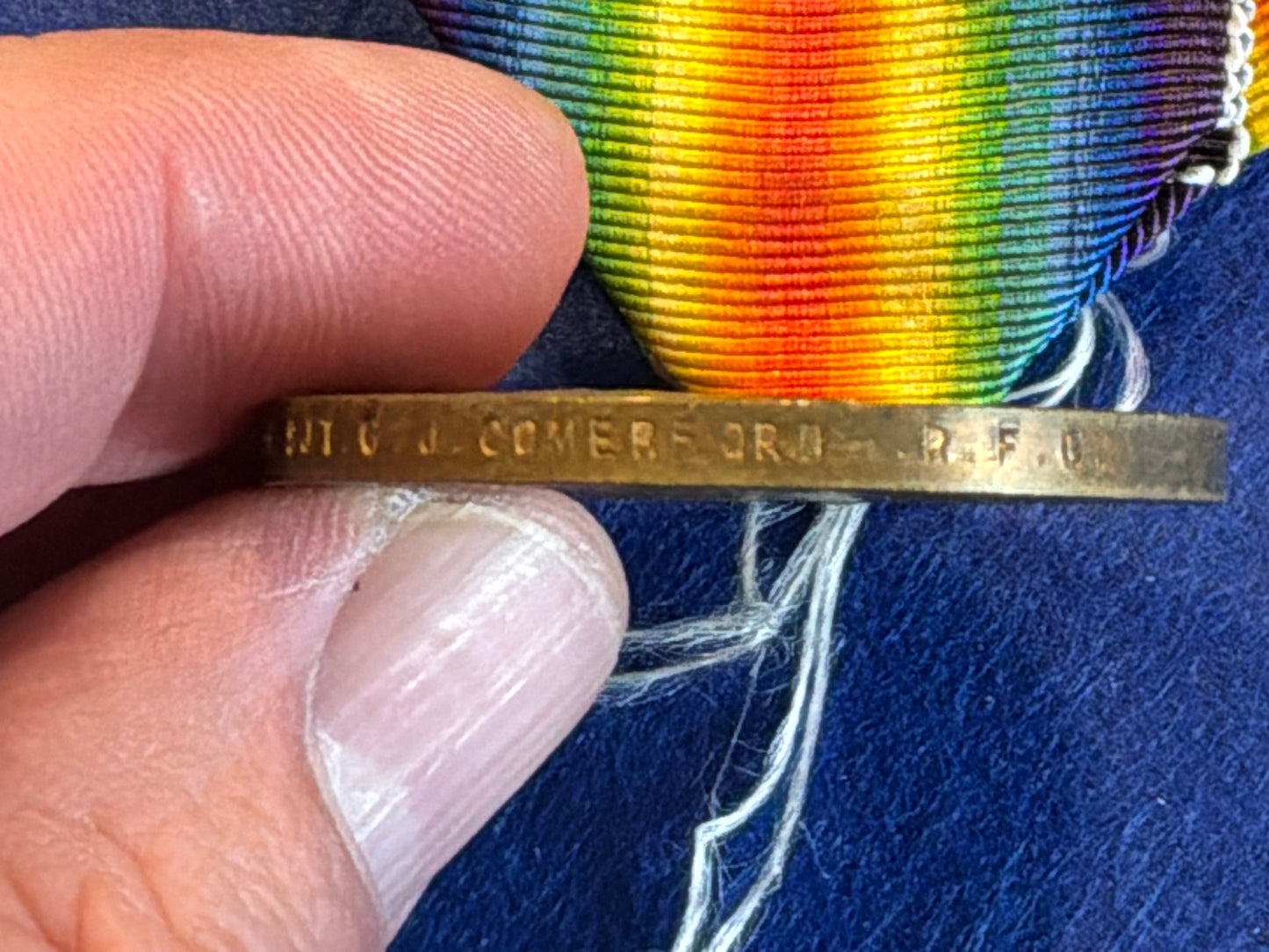
R.F.C Pilot Sgt C.COMERFORD 57th SQD K.I.A, Victory medal.
R.F.C Pilot Sgt C.COMERFORD 57th SQD K.I.A, Victory medal.
SKU:June26-31
Couldn't load pickup availability
The Story of Sergeant Charles J. Comerford, RFC
57th Squadron, Royal Flying Corps | Killed in Action 18 August 1917
|
British Victory Medal, named rim: 1166 SJT. C.J. COMERFORD R.F.C. An exceptionally rare named RFC casualty medal, accompanied by extensive copies of original squadron documents. |
Charles J. Comerford was born in Cork, Ireland, and by the time the Great War broke out he was living with his family in Gillingham, Kent, his father Lawrence Comerford residing at 70 Britton Street. He joined the Royal Flying Corps from the Royal Engineers before WW1 had started. rising to the rank of Sergeant, and was assigned service number 1166. He was 26 years old when he died.
The RFC in 1917 was an organisation under enormous strain. The spring of that year had brought the disaster of "Bloody April", when British aircrew casualties reached catastrophic levels over the Western Front. By August, 57 Squadron was operating DH.4 two-seat bomber and reconnaissance aircraft over Belgium, striking German rail infrastructure and reporting on enemy troop movements. It was demanding, dangerous work.
57 Squadron, Royal Flying Corps
No. 57 Squadron RFC was formed in June 1916 and equipped with the de Havilland DH.4, a powerful two-seat biplane that was among the best British aircraft of the war. Fast enough to outrun many German fighters when at altitude, the DH.4 served in both bombing and photographic reconnaissance roles. Its weakness was the large gap between the pilot and observer cockpits, which made communication difficult in combat.
By August 1917 the squadron was flying intensive operations over Belgian targets including the vital railway junctions at Courtrai (now Kortrijk) and Roulers (now Roeselare). The squadron record book for the period shows a relentless operational tempo, with multiple sorties flown daily despite fierce German fighter opposition.
17 August 1917: The Day Before
The squadron record book reveals that on 17 August 1917, Comerford was flying aircraft A/7545 with Air Mechanic Harmston as his observer, undertaking a Travelling Duty sortie, departing at 6.00am and returning at 8.15am. This was a relatively routine flight, likely a ferry or liaison mission rather than a combat operation.
The record book also notes other activity that day: photographic sorties over the German-held area, with exposures made using "F" type cameras. A formation of six enemy aircraft was observed going west at 10,000 feet. The skies over Flanders were busy and hostile.
18 August 1917: The Final Mission
At 5.45am on the morning of 18 August 1917, Sergeant Comerford took off in DH.4 aircraft A/7484, with Lieutenant Bell as his observer. Their assigned duty was bombing -- specifically a strike on Courtrai Sidings, a key German rail marshalling yard that the squadron had been targeting repeatedly.
They were not alone. Three other crews departed at the same time on the same bombing mission: Lieutenant Hall with Lieutenant Britton in A/7535, Lieutenant Hutcheson with Lieutenant Godwin in A/7555, and Lieutenant Cook with Lieutenant Bullock in A/7561. It was a formation strike.
The other three aircraft all returned by 7.45 to 8.20am, their observers reporting bombs dropped on Courtrai Sidings and encounters with enemy aircraft. Comerford and Bell did not return.
|
"2 x 112lb bombs dropped on COURTRAI Sidings. Missing. Last seen going down under control N.W. of ROULERS." 57 Squadron Record Book, 18 August 1917 |
The squadron record book entry is spare and factual, as operational logs invariably were. But those words -- "Missing. Last seen going down under control N.W. of ROULERS" -- tell a significant story. "Under control" in RFC terminology meant the aircraft was not spinning or on fire; it was descending in a controlled manner. This suggests the machine may have been forced down by enemy action or mechanical failure rather than destroyed outright, which may explain why Comerford has a known, marked grave rather than simply being listed as missing with no remains ever recovered.
Combat Over Courtrai: The Wider Picture
Among the documents accompanying this medal group is an Army Form W.3348 -- a "Combats in the Air" report, numbered 40, filed by another 57 Squadron crew for the same date. This report, signed by Lieutenant F.T.S. Menendez as observer, describes a DH.4 returning from bombing over Courtrai being followed by approximately 20 enemy aircraft. The observer fired two and a half drums of ammunition in bursts of five to ten rounds at ranges of around 300 yards. One enemy aircraft was seen to dive vertically from its formation, roll onto its back, and fall out of control for 8,000 feet before being lost to sight.
The commanding officer of 57 Squadron, Major L.A. Patterson, added his endorsement to the combat report: "I consider that this combat was decisive. I do not consider that pilot of E.A. could have had any tactical reason for dropping suddenly out of formation when engaged at such comparatively long range, when flying with other machines in formation."
This combat report vividly illustrates the intensity of air fighting over Courtrai that morning and afternoon. Twenty enemy aircraft pursuing a single returning bomber, bursts of fire, aircraft spinning away out of control. It was into this environment that Comerford and Bell had flown at dawn, and from which they did not return.
Harlebeke New British Cemetery
Sergeant Charles J. Comerford is buried at Harlebeke New British Cemetery in Belgium, grave reference XII D 13. Harlebeke lies just a few miles east of Courtrai.
This medal is named on the rim in impressed lettering: SJT. C.J. COMERFORD R.F.C. The presence of the RFC designation is itself notable.
More significantly still, this medal is accompanied by original primary source documents: a copy of the CWGC commemorative sheet, a page from the 57 Squadron Record Book dated 18 August 1917 showing Comerford's final sortie entry, and an original "Combats in the Air" report (Army Form W.3348) from the same squadron and date. Such documentary provenance accompanying a named medal is exceptional. Together they transform the medal from a decorative object into a fully evidenced historical artefact, allowing us to reconstruct the final hours of the man named on it with considerable precision.
Service Summary
|
Full Name |
Sergeant Charles J. Comerford |
|
Service Number |
1166 |
|
Unit |
57th Squadron, Royal Flying Corps |
|
Born |
Cork, Ireland |
|
Family Address |
70 Britton Street, Gillingham, Kent |
|
Father |
Lawrence Comerford |
|
Age at Death |
26 |
|
Date of Death |
18 August 1917 |
|
Cause |
Missing in action -- final sortie, Courtrai bombing raid |
|
Last Seen |
Going down under control, N.W. of Roulers, Belgium |
|
Aircraft |
DH.4, serial A/7484 |
|
Observer |
Lieutenant Bell |
|
Buried |
Harlebeke New British Cemetery, Belgium |
|
Grave Reference |
XII D 13 |
|
Medal |
British Victory Medal (named: SJT. C.J. COMERFORD R.F.C.) |
Share