Gradia Militaria
Rifle Brigade officers court dress coatee button 1816-32 by McGOWAN.
Rifle Brigade officers court dress coatee button 1816-32 by McGOWAN.
SKU:20276
Couldn't load pickup availability
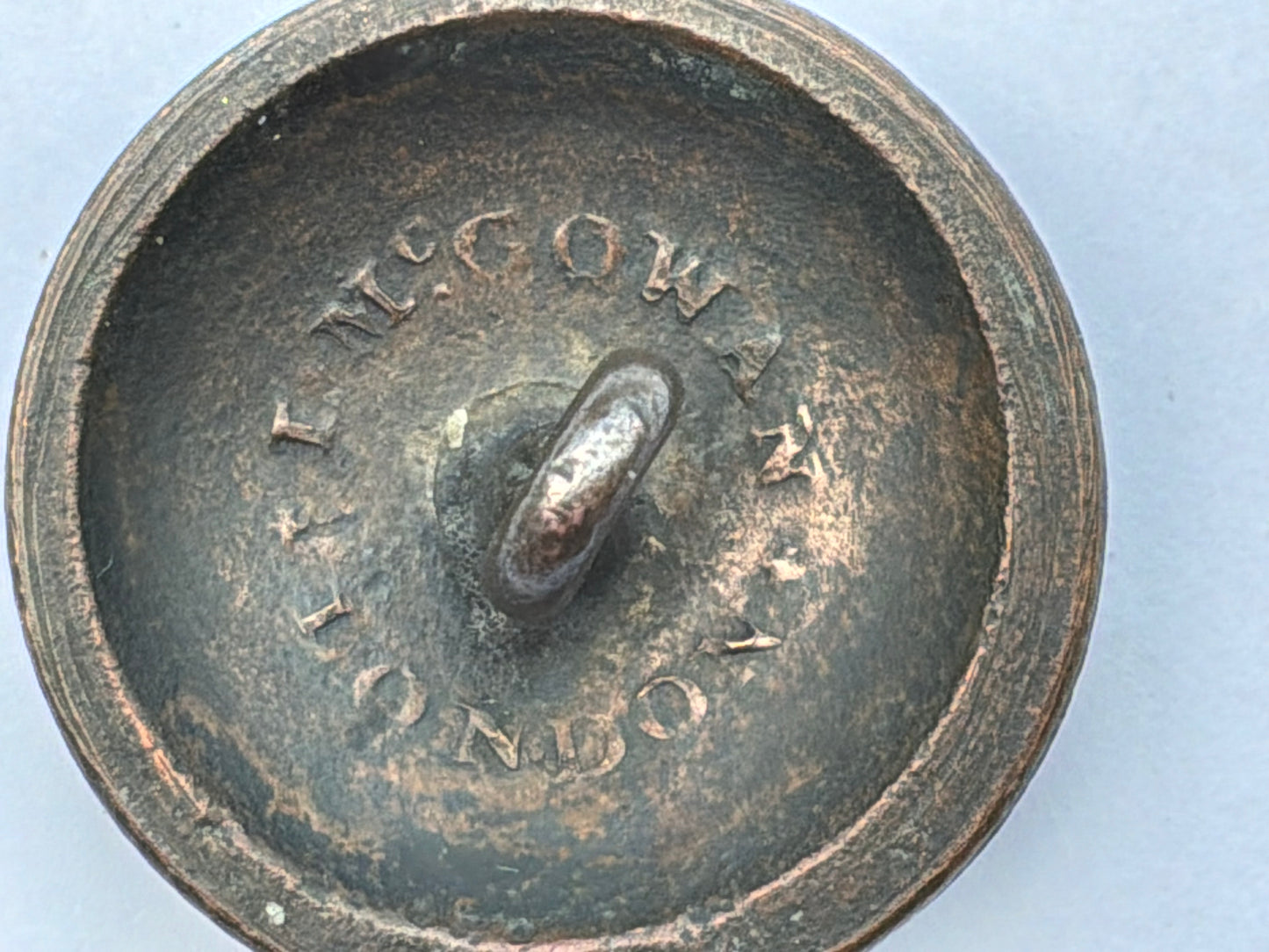
Approximately 23mm across. Rifle Brigade officer's court dress coatee button, c.1816 to 1832, by I. McGowan of London
A rare silver-plated officer's button from the court dress coatee of the Rifle Brigade, in the same pattern worn by the Duke of Wellington himself.
The design
The face shows a crown above the letters R B, with the regiment's strung bugle horn and trefoil bow below. Around them runs a band bearing the battle honours "Peninsula" and "Waterloo", all within a laurel wreath. Both honours were hard won. The regiment served in the Peninsular War from start to finish and earned seventeen battle honours there, more than any other regiment in that campaign. At Waterloo in 1815, all three of its battalions were in the field.
A new name after Waterloo
The button cannot be earlier than 1816. Until then the regiment was the 95th Rifles. On 16 February 1816, while serving with the Allied Army of Occupation in Paris, it was taken out of the numbered line and renamed simply The Rifle Brigade, a rare honour that set it apart from the rest of the army. It stayed in France until the occupation ended in 1818.
The Wellington connection
In 1820 the Duke of Wellington became Colonel-in-Chief of the Rifle Brigade, a post he held until his death in 1852. The crown on this button is linked to him, adopted as a regimental badge in 1820.
Wellington connection
In 1820 the Duke of Wellington became Colonel-in-Chief of the Rifle Brigade, a post he held until his death in 1852. The crown on this button is linked to him, adopted as a regimental badge in 1820.
Wellington's own Rifle Brigade court dress survives in the Royal Green Jackets (Rifles) Museum in Winchester. It is a long-tailed coatee, originally dark green, with black facings, silver epaulettes and silver buttons embossed with the bugle horn, R B, "Peninsula" and "Waterloo". This button is the same pattern.
The maker
The reverse carries a crisp, fully legible backmark: I. McGOWAN LONDON. The "I" is the period way of writing a "J", and the maker was J. McGowan, a manufacturer of military buttons in Soho. He worked from 38 King Street, Soho, from 1802 to 1804, moved to Gerrard Street, Soho, in 1805, and the business was still trading in 1844.
McGowan made buttons for regiments across the British Army during the Napoleonic era. Examples bearing his mark are held by the McCord Stewart Museum in Montreal, the National Museum of the Royal Navy, and Limerick Museum.
Condition;Silver plate on the face with even age toning. Open back with original loop shank intact. Backmark clear and complete.
Share