Gradia Militaria
Royal Engineers Transportation Training Centre formation sign
Royal Engineers Transportation Training Centre formation sign
SKU:10104
Couldn't load pickup availability
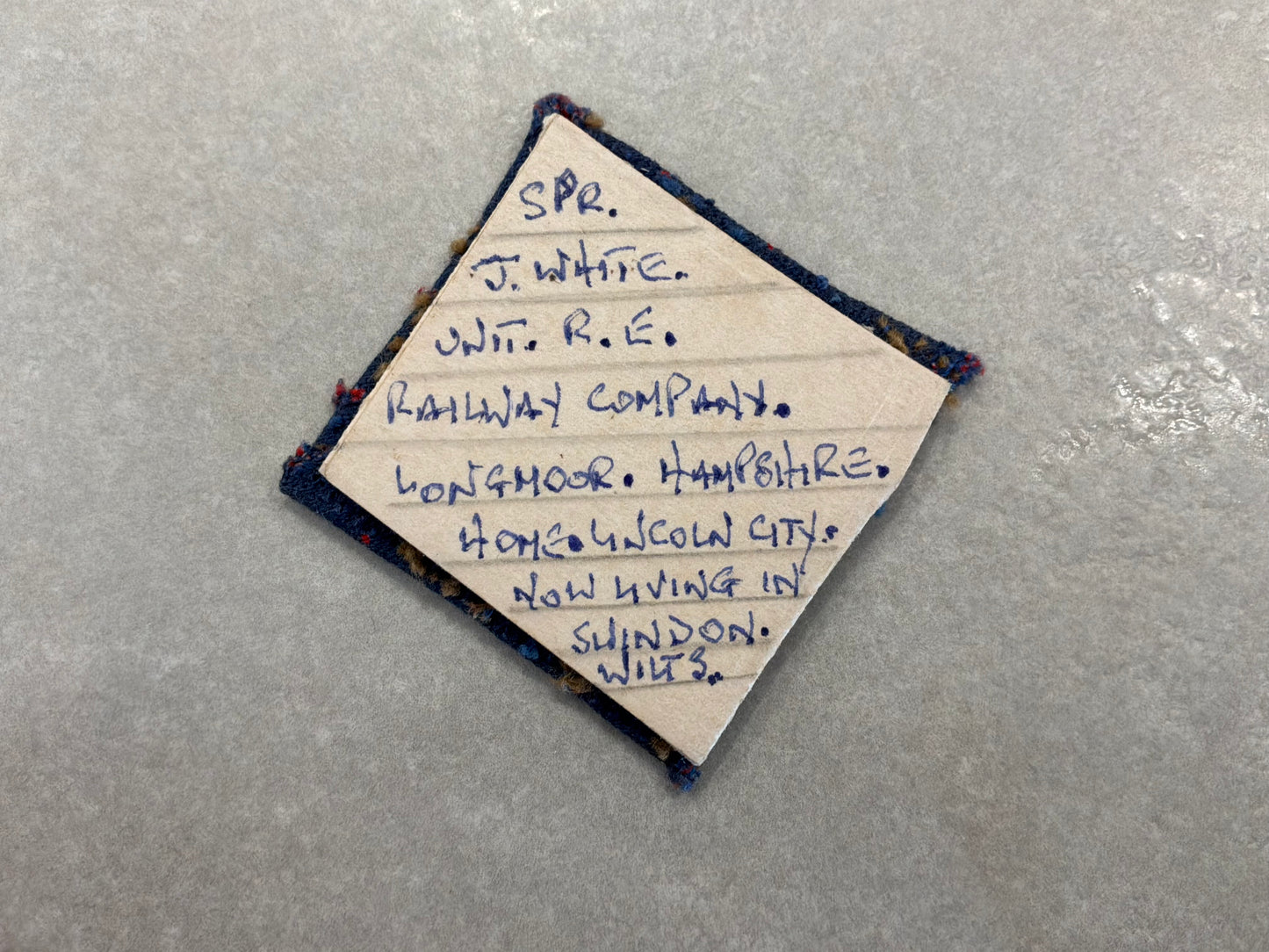
Royal Engineers Transportation Training Centre printed formation sign , unusually the original wearer has attached a card label on the rear with his personnel information, So this identifies the original owner as Sapper J. White of the Royal Engineers Railway Company, stationed at Longmoor in Hampshire, originally from Lincoln, later resettled in Swindon, Wiltshire.
On the Royal Engineers and Longmoor:
Longmoor, in East Hampshire, was the home of the Longmoor Military Railway, a British military railway built by the Royal Engineers from 1903 to train soldiers on railway construction and operations, which ceased operation on 31 October 1969. It grew out of an earlier line: the Woolmer Instructional Military Railway at Bordon/Longmoor, set up to give courses in railway operation and track building and maintenance, following lessons learned in the Crimean and Boer Wars about the value of military rail supply lines.
By the interwar and WWII period it had become a full training centre. The association of military and civilian railway and docks organisations, begun in 1924, meant units came successively to Longmoor to train and practice their roles, with the whole establishment shifting focus to war preparation from 1938 onward. After 1945, its main work was demobilising and rehabilitating wartime railwaymen, recovering and disposing of huge stocks of returned equipment, and reorganising training for regular and reserve railway units, alongside operational demands in Palestine, Korea and Egypt.
The unit badge itself lived on institutionally: the modern-day Railway Squadron started life in the Royal Engineers at Longmoor Military Camp, known as the Longmoor Military Railway, operating steam locomotives, before later becoming part of the Royal Logistic Corps.
So Sapper White would have been one of many Royal Engineers railwaymen who passed through Longmoor for this specialist rail transport training, likely sometime in the mid-20th century given the note’s style, before eventually settling in Swindon, a town itself long associated with the railway industry through the GWR works.
Share