Gradia Militaria
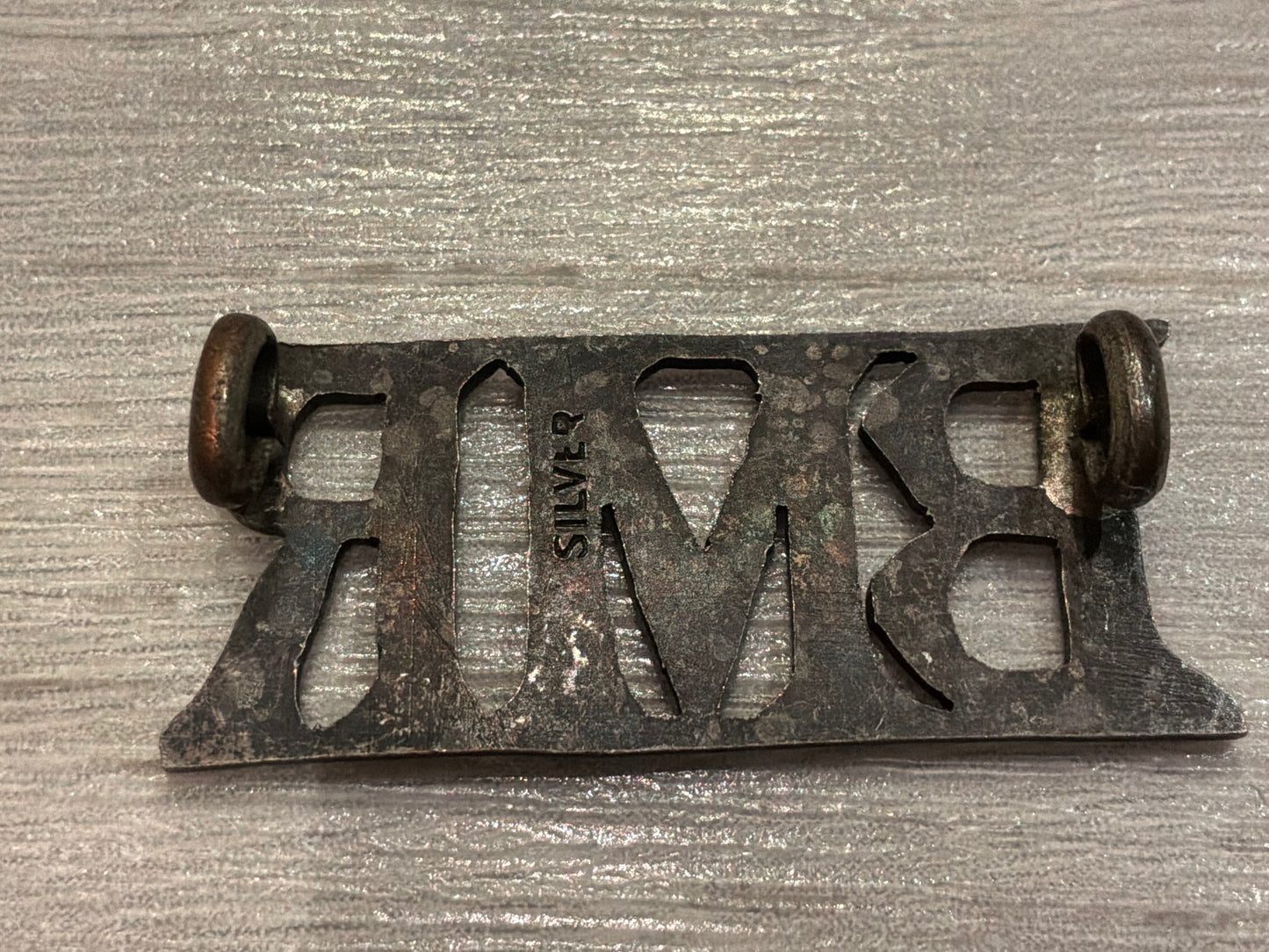
S.A Boer war, B.M.R (Border Mounted Rifles) officers silver shoulder title.
S.A Boer war, B.M.R (Border Mounted Rifles) officers silver shoulder title.
SKU:
Couldn't load pickup availability
Rare South African Boer war, B.M.R (Border Mounted Rifles) officers silver shoulder title worn from 1894-1914. Sheet cut title stamped silver on rear
Khaki field service dress, adopted in 1897, had green shoulder straps carrying the block letters B.M.R. in white metal. All of the regiment's insignia were white metal, a sign of its volunteer status. A sterling version of a white metal title fits an officer's private purchase piece. The period of use is 1897 to about 1913-14, and the Boer War sits squarely inside that.
The regiment served as the Border Mounted Rifles until 1913-14, when it was merged into the new Union Defence Force.
Who they were
- Formed 1894. Natal's coastal mounted regiments were amalgamated in 1888 as the Natal Mounted Rifles. In 1894 the unit was split in two, and the southern wing took the name Border Mounted Rifles, headquartered at Ixopo.
- Where they recruited. The Natal coast south of Isipingo, out to the borders with Pondoland, East Griqualand and Pietermaritzburg County. The men were of English, German and Norwegian descent.
- Unpaid volunteers. Members supplied their own horse, saddlery and clothing, and were paid only for training camps and active service.
- Motto. In 1899 the Governor visited their spartan mess and called it "rough and ready". The medical officer set a top boot and spur on the table as their "only plate". That led to the boot and spur crest and the motto "Rough but Ready".
Boer War service
- Called up on 29 September 1899 and at Ladysmith within two days, under Major J. F. Rethman, as part of the Natal Volunteer Brigade. They went to war 286 strong.
- Before Ladysmith was surrounded they fought at Tintanyoni, Bester's Farm and Lombard's Kop. At Rietfontein, Major Sangmeister of the BMR helped seize a kopje under heavy fire and bring a Maxim into action. The BMR had 9 wounded that day.
- Siege of Ladysmith. 260 BMR men were in the garrison. They took part in the night raid that destroyed the Boer big guns on Gun Hill. On 6 January 1900, a BMR squadron climbed Caesar's Camp alongside the Gordons and helped drive the Boers off the crest.
- Disease, hunger and constant duty cut them to half strength. Many horses were slaughtered and eaten.
- BMR men rode in with Dundonald's relief force on 28 February 1900.
- After Ladysmith. They advanced north with the Imperial forces that drove the Boers out of Natal, then guarded northern Natal against raids. About fifty volunteered to serve on in the Natal Volunteer Composite Regiment.
- Losses. 1 officer died, 12 other ranks killed or died of disease, and about 18 wounded.
After the war
- King Edward VII awarded them King's Colours in 1904 for Boer War service.
- They served in the 1906 Natal rebellion and the 1907 Dinuzulu expedition.
- In January 1914, still as the BMR, they guarded Natal's railways during the general strike. By August 1914 they had merged with the NMR as the 3rd Mounted Rifles (N.M.R.).
Khaki field service dress, adopted in 1897, had green shoulder straps carrying the block letters B.M.R. in white metal. All of the regiment's insignia were white metal, a sign of its volunteer status. A sterling version of a white metal title fits an officer's private purchase piece. The period of use is 1897 to about 1913-14, and the Boer War sits squarely inside that.
Share