Gradia Militaria
Scots Guards bed plate; served 21 years, Boer War & WW1 B.E.F.
Scots Guards bed plate; served 21 years, Boer War & WW1 B.E.F.
SKU:
Couldn't load pickup availability
The plate and the man
A brass duty plate engraved "1/Scots Guards, 2713, C.C. Chick" once hung on a barrack bed. Its owner, Charles Courtney Chick, was a baker from Weymouth who served 21 years without a single mark on his conduct sheet. He fought through the Boer War, landed in France with the original British Expeditionary Force in August 1914, trained colonial troops in Egypt, and finished the Great War as Regimental Sergeant Major of a Royal Berkshire battalion.
The plate was made by Hobson & Sons of Lexington Street, London, a major army contractor. It showed his name and number when he was in barracks.
A baker from Weymouth
Charles Courtney Chick was born in late 1878 in the parish of Chapelhay, Weymouth, Dorset. His father, William John Chick, lived at 12 Spring Gardens, Weymouth. His mother was Agnes.
On 4 April 1899, aged 20 years and 4 months, he walked into the recruiting office at Dorchester. He gave his trade as baker. He was already a part-time soldier in the 1st Volunteer Battalion, Dorset Regiment, and it was a sergeant of that battalion who had given him his recruiting notice.
He signed on for "short service": 7 years with the colours and 5 in the reserve.
He was passed fit for the Scots Guards that same day and joined the regiment in London on 9 April 1899 as Private 2713. Within weeks he was at the Guards depot at Caterham.
Everything below comes from his surviving service and pension papers (WO 364), his Boer War medal roll (WO 100) and his First World War medal roll (WO 329).
The Boer War, 1899 to 1902
Six months after enlisting, Private Chick sailed for South Africa. He embarked with the 1st Battalion Scots Guards on the SS Nubia on 21 October 1899 and stayed almost three years, until 4 October 1902.
His Queen's South Africa Medal roll shows five clasps, which trace his war:
- Belmont, 23 November 1899. The Scots Guards took the heights at the point of the bayonet. His first action, seven months after leaving the bakery.
- Modder River, 28 November 1899. The battalion lay pinned down all day under rifle and pom-pom fire.
- Magersfontein, 11 December 1899. No clasp was issued, but the Guards Brigade was in support and he was almost certainly there.
- Paardeberg, February 1900. The surrender of the Boer General Cronje.
- Driefontein, 10 March 1900. The last fight before the march into Bloemfontein.
- Transvaal. Later service in the Transvaal during the long guerrilla phase of the war.
He does not have the Johannesburg, Diamond Hill or Belfast clasps that much of the battalion earned in mid 1900. His medical sheet records "no admission" for the whole of his time in South Africa, so it was not sickness. He was most likely detached on other duties for those months, but the records do not say.
He did well. He was granted good conduct pay on 4 April 1901 and made Lance Corporal on 2 August 1901. He also received the King's South Africa Medal with the 1901 and 1902 clasps, and a £5 war gratuity for the campaign.
Everything below comes from his surviving service and pension papers (WO 364), his Boer War medal roll (WO 100) and his First World War medal roll (WO 329).
He does not have the Johannesburg, Diamond Hill or Belfast clasps that much of the battalion earned in mid 1900. His medical sheet records "no admission" for the whole of his time in South Africa, so it was not sickness. He was most likely detached on other duties for those months, but the records do not say.
He did well. He was granted good conduct pay on 4 April 1901 and made Lance Corporal on 2 August 1901. He also received the King's South Africa Medal with the 1901 and 1902 clasps, and a £5 war gratuity for the campaign.
A career Guardsman, 1902 to 1914
Back home, Chick climbed steadily through the ranks while the battalion moved between Windsor, Aldershot and the London barracks.
- 1 January 1903: promoted Corporal. He earned a 2nd class certificate of education in February.
- 1904: passed for promotion to Sergeant and made unpaid Lance Sergeant on 4 July, paid from November 1905.
- 2 January 1906: extended his service to complete 12 years with the colours. He also qualified in transport.
- 1 March 1907: promoted Sergeant. That July he attended the School of Musketry at Hythe.
- 13 April 1908: re-engaged to complete 21 years. He had chosen the army as his life.
Egypt, 1911 to 1913
In November 1910 he was passed fit for service in Egypt. He sailed with the 1st Battalion on 25 February 1911 and spent almost two years in Cairo, where he was inoculated against typhoid. He returned home on 2 January 1913.
France, 1914: one of the Old Contemptibles
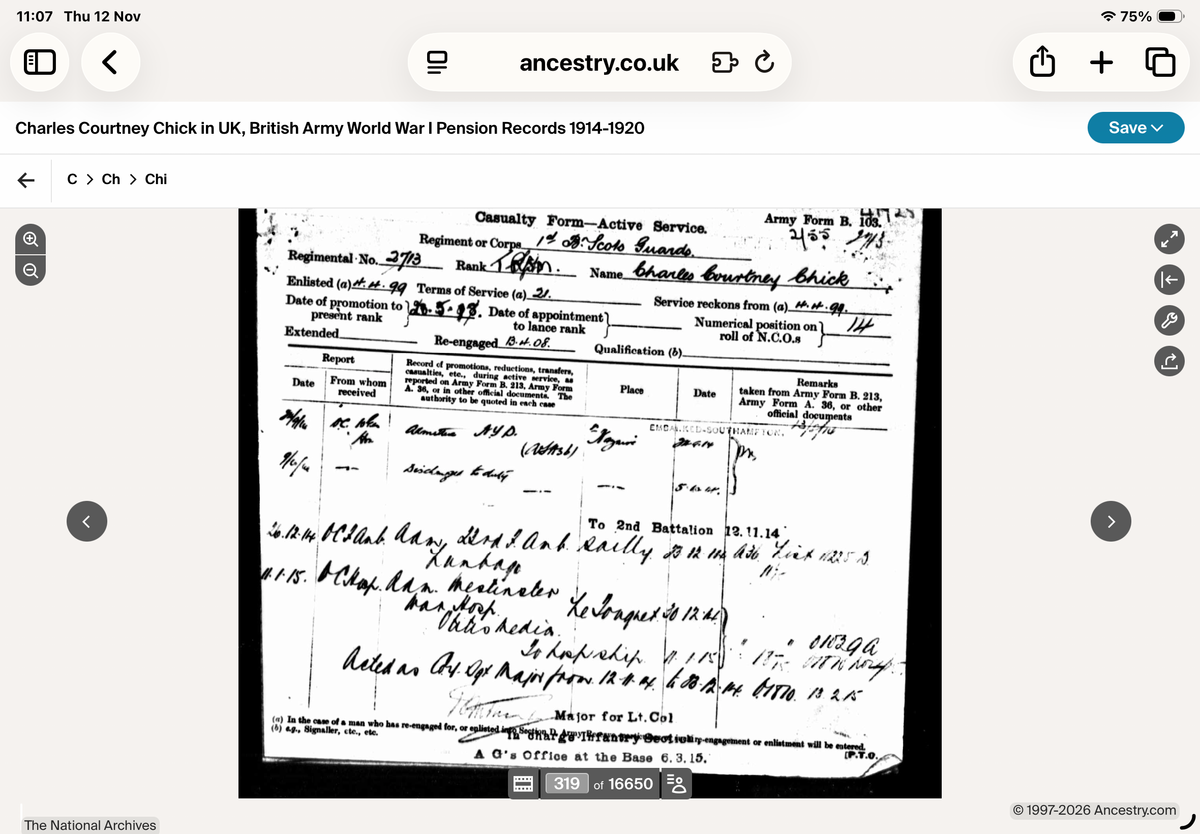
When war came, Sergeant Chick was 35 and a 15 year veteran. He was passed fit for active service at Aldershot and embarked at Southampton with the 1st Battalion on 13 August 1914, nine days after Britain declared war. That makes him one of the original British Expeditionary Force, the "Old Contemptibles" of Mons and the retreat.
- September 1914: admitted to hospital with an illness "not yet diagnosed", probably at St Nazaire. He was discharged back to duty on 5 October.
- 12 November 1914: posted to the 2nd Battalion, which had been shattered at the First Battle of Ypres. He was made acting Company Sergeant Major from that date.
- 23 December 1914: admitted to a field ambulance with lumbago.
- 30 December 1914: admitted to the Westminster War Hospital at Le Touquet with otitis media, a middle ear infection.
- 11 January 1915: sent home on a hospital ship.
He had served 153 days in France. He was posted to the 3rd (Reserve) Battalion on 12 January 1915 to recover.
Egypt, 1915 to 1916: training the colonials
Instead of returning to the trenches, Chick was sent to Egypt "for employment with the Colonial Contingent". Experienced Guards NCOs were prized as instructors, and he was one of them.
- 29 April 1915: sailed from Devonport on the troopship Lake Manitoba.
- 13 May 1915: landed at Alexandria and joined the school of instruction at Zeitoun, near Cairo, as an instructor. Zeitoun was the main training base for Australian and New Zealand troops.
- 20 June 1916: appointed Acting Staff Sergeant with pay.
- 11 August 1916: sent to Kantara on the Suez Canal on instructional duties, a week after the Battle of Romani.
- 1 September 1916: returned to Zeitoun from the canal.
- 22 September 1916: sailed from Alexandria for Marseilles to rejoin his regiment, reverting to Sergeant.
He was back in England by 4 October 1916, after 1 year and 157 days in Egypt.
A new regiment
After 8 months home with the 3rd Battalion, his 18 years as a Scots Guardsman came to an end. On 25 May 1917 he was transferred as a Sergeant to the Royal Berkshire Regiment and given the new number 41725.
Regimental Sergeant Major, 1917 to 1918
In the Royal Berkshires, Chick's long experience was put straight to use. Within two weeks of landing in France he was running a battalion's discipline as its Regimental Sergeant Major.
- 1 September 1917: embarked at Southampton, landing at Le Havre the next day and joining the 46th Infantry Base Depot.
- 15 September 1917: joined the 6th Battalion, Royal Berkshire Regiment, in the field.
- 13 to 16 September 1917: promoted Company Sergeant Major (Warrant Officer Class II) and appointed acting Regimental Sergeant Major with pay.
- 1917: awarded the Long Service and Good Conduct Medal (Army Order 312 of 1917).
- 30 January 1918: 14 days' leave to the UK. While he was away the 6th Battalion was broken up in the army's reorganisation, and he reverted to CSM on 2 February.
- 4 March 1918: back in France via Rouen.
- 12 April 1918: posted to the 2/4th Battalion, Royal Berkshire Regiment, and again made acting RSM. This was the height of the German spring offensive.
- 20 May 1918: promoted Temporary Warrant Officer Class I and appointed Regimental Sergeant Major for the duration of the war.
He was on leave in England from 8 to 22 November 1918, so the Armistice found him at home. Back in France, he was admitted to hospital at Abbeville on 16 December 1918 for minor surgery. He was shipped home on the hospital ship St Denis on 10 January 1919 and spent 20 days at Charing Cross Hospital before going on leave.
Home, discharge and medals, 1919 to 1920
Chick saw out his time as a Regimental Sergeant Major at home. He was posted to the regimental depot on 11 January 1919, then to the 3rd Battalion on 28 March 1919, with an entry recorded in Dublin. He joined the 2nd Battalion on 9 August 1919. A planned transfer to the Worcestershire Regiment in January 1920 was cancelled.
On 26 February 1920, aged 41, he signed a statement that he claimed no disability from his service. He went through the London dispersal unit on 16 March 1920, still graded medical category A. He was discharged on 12 April 1920 "on termination of second period of engagement", as a Warrant Officer Class I.
He had served 21 years and 9 days, almost exactly the 21 years he signed up for in 1908. His conduct sheet carries a single certificate: there was no record of him incurring any regimental entry in his entire service. His home address on leaving was 11 Sutherland Street, Pimlico, London. His wife's address was 27 Greencoat Mansions, Westminster.
Share