Gradia Militaria
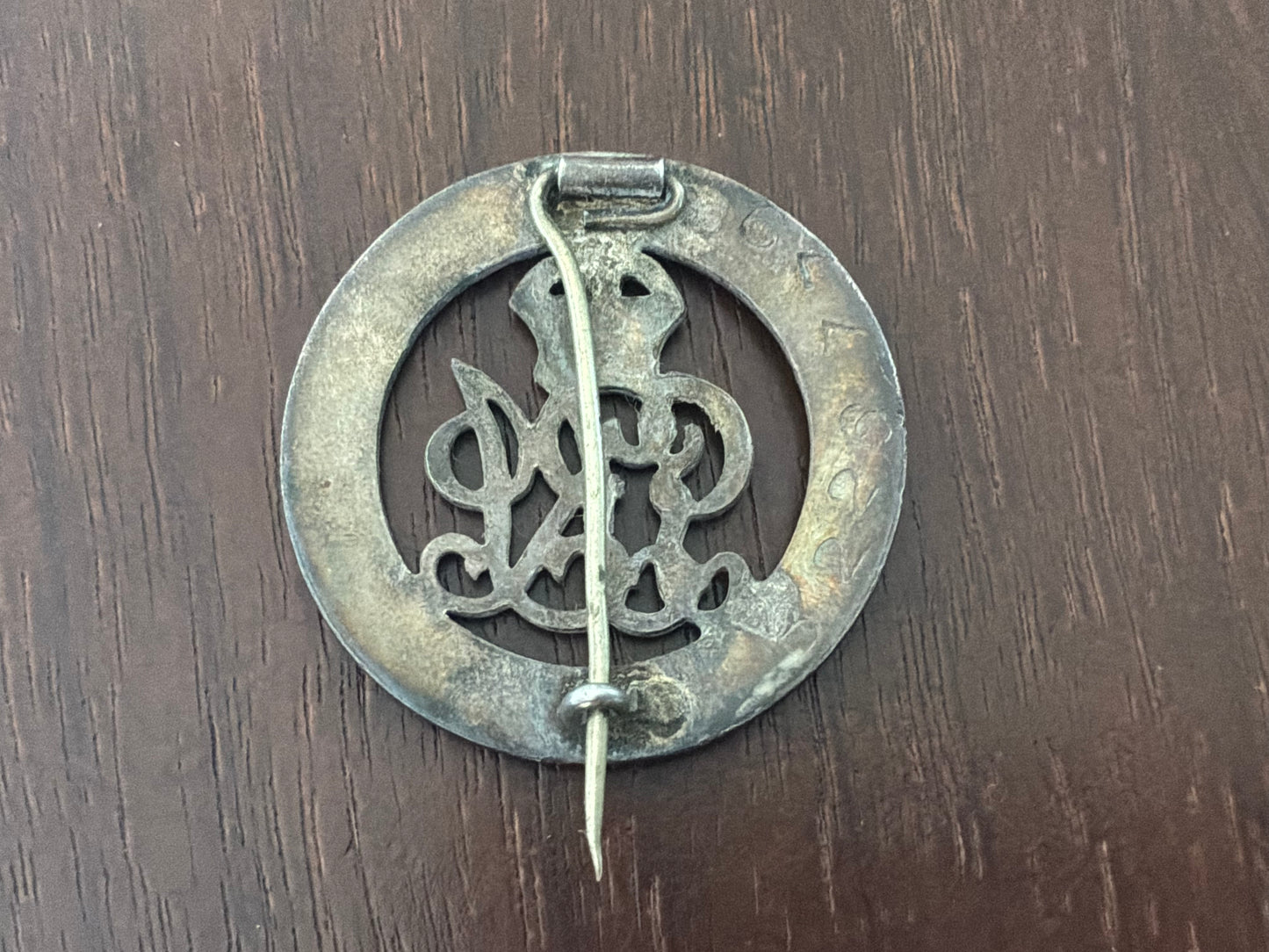
SWB; Jewish soldier, Sgt Cosman Schoenthal, RAMC
SWB; Jewish soldier, Sgt Cosman Schoenthal, RAMC
SKU:10083
Couldn't load pickup availability
A Soldier’s Badge, A Family’s Pride: Sgt Cosman Schoenthal, RAMC
This particular badge, number B226779, was issued to Sergeant Cosman Schoenthal of the Royal Army Medical Corps (RAMC), Army Number 6217.
From Bow to the 11th Hussars
According to the notes accompanying the badge, Cosman Schoenthal originally enlisted on 18 October 1910, at the age of 18, joining the 11th Hussars, and gave his home as Bow, in London’s East End. This detail matters: Bow sat at the edge of the great Jewish immigrant community of the East End, and a Jewish teenager choosing the cavalry, rather than a trade or family business, would have been an unusual and notable step for the period.
At some point between his enlistment and the war he transferred, or was transferred, from the 11th Hussars into the Royal Army Medical Corps, where he rose to the rank of Sergeant. He was discharged on 12 April 1919 on grounds of sickness, which is consistent with the criteria for the Silver War Badge.
A Family of Soldiers
The Jewish Chronicle of 2 October 1914, headed “Proud of Being a Soldier,” gives a rare window into the Schoenthal family at the very start of the war. It reports that a Corporal H. Schoenthal of the 1st Essex Regiment had written home from Vacoas, Mauritius, describing his regiment’s excitement on hearing they were nearly at war with Germany. The same article records a letter from “a brother of the Corporal, Private Cosman Schoenthal,” writing from camp on 30 August 1914, who says he expects to be made lance-corporal or corporal shortly, jokes about the state of the Royal Navy, and writes proudly to his parents that “the honour will rebound on to your shoulders for having two sons who are both proud to be in the Army.”
Research into Harry Schoenthal, cross-referenced independently through the Western Front Association’s work on Jewish soldiers of the First World War, confirms a Lance-Sergeant Harry Schoenthal serving with the 29th Cycle Company in the Gallipoli campaign, who wrote home in 1915 describing his encounters with the Jewish volunteers of the Zion Mule Corps. It is likely, though not certain from the sources gathered here, that this Harry Schoenthal is the same “Corporal H. Schoenthal” of the Jewish Chronicle piece, since both accounts place a Schoenthal brother in a cyclist or light infantry role in the same period, and the Jewish Chronicle piece explicitly frames Cosman as “beating Harry’s rank soon.”
Taken together, the newspaper article and the badge tell the story of two Jewish brothers from Bow who both served, one of them (Cosman) starting in the cavalry before the war and ending it as a Sergeant in the RAMC, discharged through sickness after more than eight years of service.
The Puzzle of the Medals
Your question about why Cosman Schoenthal appears entitled only to the British War Medal and Victory Medal, and not to the 1914 Star or 1914-15 Star, has a straightforward technical answer rooted in how those two Star medals were awarded.
• The 1914 Star was awarded only to those who served ashore in France or Flanders between 5 August and 22 November 1914.
• The 1914-15 Star was awarded to anyone who served in any theatre of war (not just at home) between 5 August 1914 and 31 December 1915, provided they had not already qualified for the 1914 Star.
• The British War Medal and Victory Medal, by contrast, were awarded much more broadly, to anyone who served overseas, or in some cases simply served, during the war years, including men who did not go overseas until 1916 or later.
Cosman Schoenthal’s Jewish Chronicle letter of August 1914 was written “from camp,” not from an overseas posting, and simply says he is “under orders to move” with no idea where. This strongly suggests he was still in Britain, training or on home service, at the point the 1914 and 1914-15 Star eligibility windows applied. If he did not actually enter a theatre of war until after 31 December 1915, whether because he remained on home postings, was training as a medical orderly after his transfer to the RAMC, or was held back for some other reason, he would have missed both Star medals entirely while still qualifying for the War Medal and Victory Medal once he did serve. This is a common pattern for men who transferred between corps mid-war, since retraining, such as the medical instruction needed to become an RAMC NCO, could take a soldier out of the deployment cycle for a year or more.
Share