Gradia Militaria
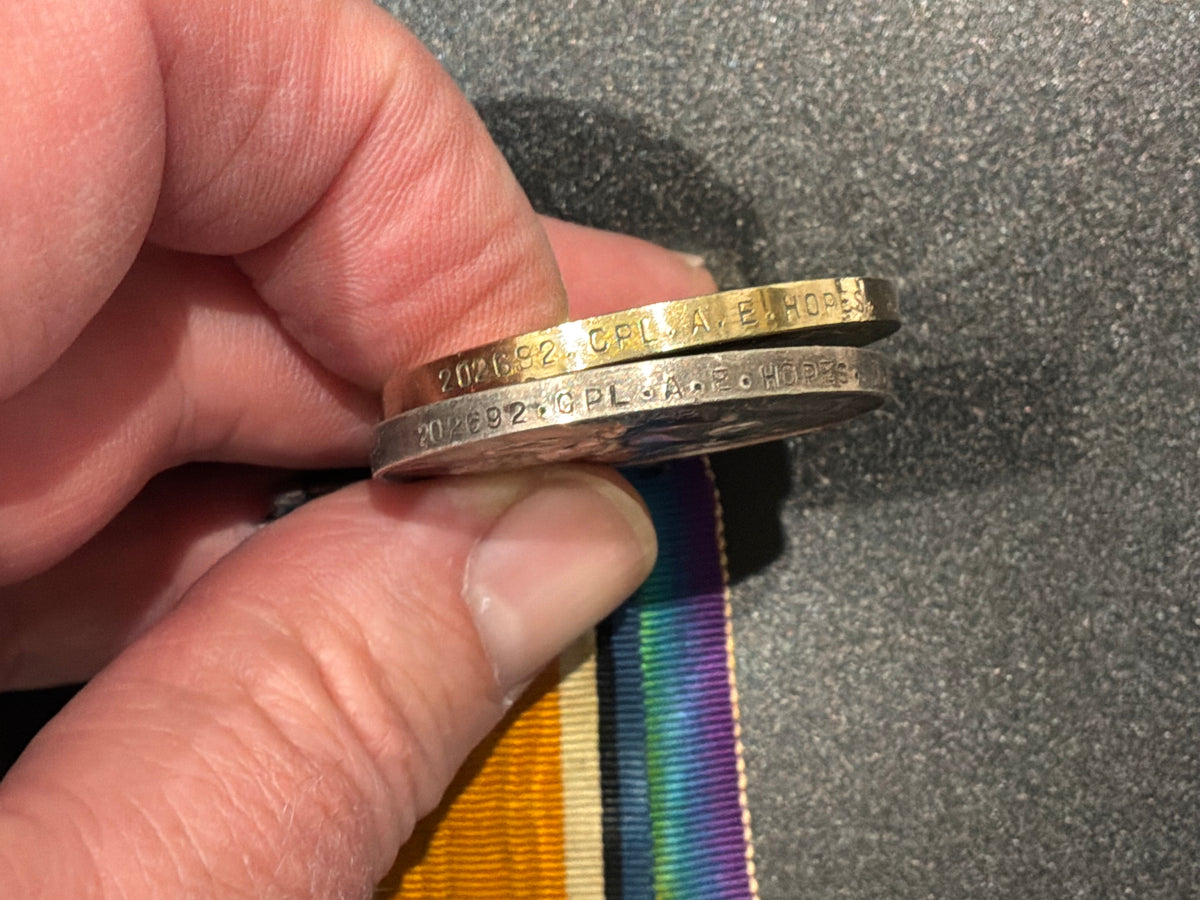
WW1 British War & Victory Medal pair, 202692 Cpl A.E. Hopes, RAF, RNAS Kite Balloons, Gallipoli / Mesopotamia
WW1 British War & Victory Medal pair, 202692 Cpl A.E. Hopes, RAF, RNAS Kite Balloons, Gallipoli / Mesopotamia
SKU:
Couldn't load pickup availability
A First World War British War Medal and Victory Medal pair, correctly impressed to 202692 CPL. A.E. HOPES. R.A.F.
Albert Edward Hopes joined the Royal Naval Air Service (RNAS) as a carpenter in 1914. He served at Gallipoli and then with a naval kite balloon section in Mesopotamia, now Iraq. He finished the war as a corporal mechanic in the newly formed Royal Air Force. It makes for an unusual pair, with researched service.
Good condition for age.
From cabinet maker to the RNAS
Albert was born on 29 May 1895 in Shipston-on-Stour, Worcestershire, and worked as a cabinet maker. On 14 December 1914 he signed on with the Royal Naval Air Service as an Air Mechanic 2nd class, trade carpenter, with the number F2692.
In those days aircraft and balloon equipment were made largely of wood, wire and fabric, so skilled carpenters were in demand.
Gallipoli
Albert went out to the Dardanelles on 28 May 1915, a month after the famous landings, and served there until February 1916.
The RNAS played a key role in the campaign, flying aircraft from the nearby islands and observation balloons from specially converted ships. These balloons spotted targets for the Royal Navy's guns.
Kite balloons in Mesopotamia
His naval record shows that he joined a kite balloon section on 8 April 1916 and served with it until October 1917. This matches his time in Mesopotamia on his RAF record.
He arrived during the last weeks of the siege of Kut, where British aircraft flew the world's first military airlift to the starving garrison before it surrendered on 29 April 1916.
Kite balloons were tethered hydrogen balloons. An observer in a basket underneath spotted enemy positions and directed artillery fire by telephone. The ground crew handled the winch, the gas and the repairs.
The navy's balloon section in Mesopotamia was No. 14 Kite Balloon Section, RNAS, which served with the army through the advance to Baghdad in 1917.
Roehampton and the RAF
In October 1917 Albert came home to the RNAS balloon depot at Roehampton. When the RNAS and Royal Flying Corps merged on 1 April 1918, he became Corporal Mechanic 202692 in the new Royal Air Force.
He went back out to the Middle East from April 1918 to February 1919. His conduct was rated very good throughout.
Service record
- 14 December 1914: joined the RNAS, Air Mechanic 2nd class (carpenter), F2692
- 1 June 1915: Air Mechanic 1st class
- 28 May 1915 to 8 February 1916: Dardanelles
- 8 April 1916 to 10 October 1917: kite balloon section, Mesopotamia
- 11 October 1917: Roehampton
- 1 February 1918: Leading Mechanic
- 1 April 1918: transferred to the RAF as Corporal Mechanic 202692
- 16 April 1918 to 20 February 1919: Middle East
- 1 April 1919: discharged
- 1920: Silver War Badge number RAF 10833, which was issued to men discharged because of wounds or sickness
Medal entitlement
Albert was also entitled to the 1914-15 Star for his Gallipoli service. It would have been issued by the Admiralty and named to his RNAS number, and is not included here.He may never have even received it as it was sent via another service.
Share