Gradia Militaria
WW1 Department of the General Auditor cap badge by Gaunt.
WW1 Department of the General Auditor cap badge by Gaunt.
SKU:
Couldn't load pickup availability
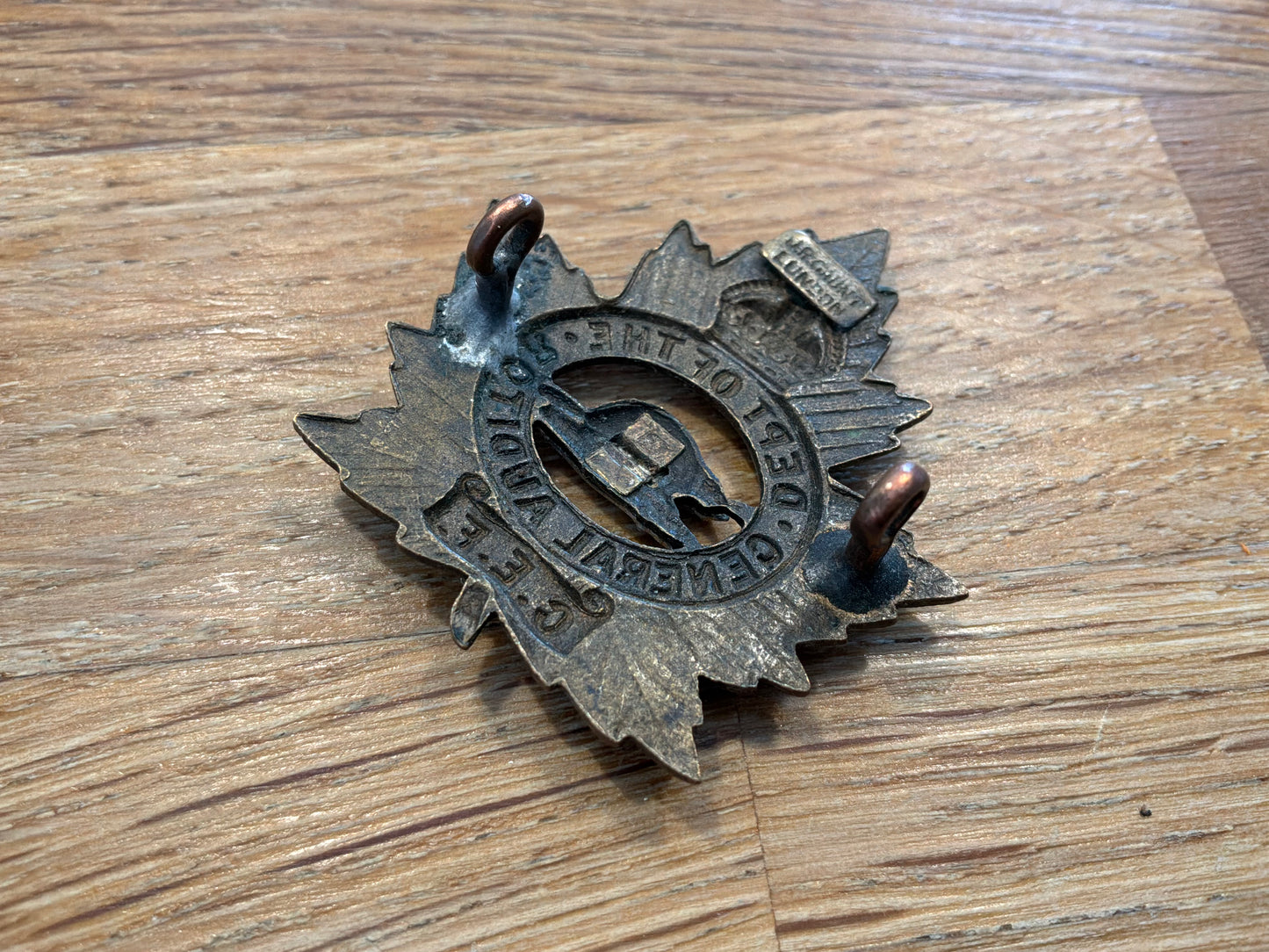
Very rare C.E.F Department of the General Auditor cap badge by J.R GAUNT LONDON.
Please note that the left hand rear loop has a period soldier repair.
WW1 Canadian Expeditionary Force cap badge: Department of the General Auditor, C.E.F., bi-metal, by J.R. Gaunt, London
A rarely encountered bi-metal cap badge of the Department of the General Auditor, Canadian Expeditionary Force. The design is a bronzed maple leaf, surmounted by a King's crown, with the title "DEPT OF THE GENERAL AUDITOR" in a pierced oval band. At the centre is a separately struck white-metal beaver on a log, and below is a "C.E.F." scroll. The reverse carries the maker's tab "J.R. GAUNT LONDON" and two copper loop fasteners (one with a repair)
The men behind the money
Canada paid for its own army in the Great War, and every dollar spent overseas had to be accounted for. That job fell to a small, little-known department based in London: the Department of the General Auditor.
It was set up in 1915 by Colonel L. A. Dowie, who organised and ran it. Its staff establishment was formally approved by Order-in-Council 1614 of 1917.
Canada's overseas army was run from London, where the Ministry of the Overseas Military Forces of Canada had its offices and its headquarters at Argyll House on Regent Street. By the end of the war the Canadian Army Pay Corps had almost 2,000 military and civilian staff overseas. The auditors were the check on all of them.
Their working day ran to a strict rhythm. By day, Pay Corps clerks posted the soldiers' pay ledgers. Each night, the General Auditor's staff checked them.
Every bill went through their hands as well. Invoices for supplies were checked, approved by the Overseas Purchasing Committee, and then passed to the General Auditor for pre-audit before the Paymaster-General would pay a penny.
They audited the accounts of cash sales made by Canadian units. When stores went missing from a quartermaster's charge, a board of inquiry sat to decide who was responsible, and only the General Auditor could approve writing the loss off.
It was a desk war of ledgers, invoices and signatures, fought in London offices rather than the trenches. But it kept a force of hundreds of thousands paid and supplied. The department was so small that its badges are seldom seen today.
Condition: good, with an even dark bronzed finish and a well-detailed beaver. The lower loop shows old solder, consistent with a period re-fixing. Both loops are present.
Share