Gradia Militaria
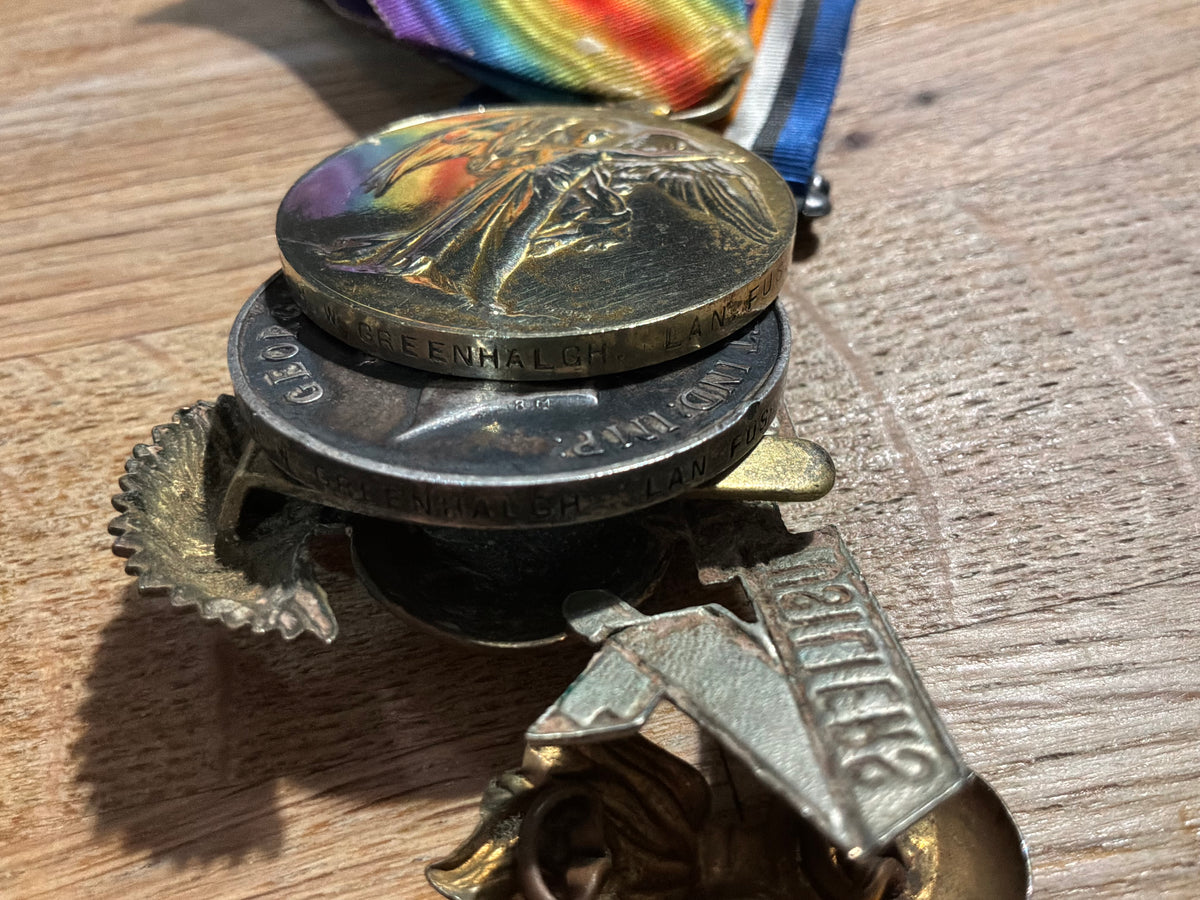
WW1 British War & Victory Medals, Silver War Badge, 40828 Greenhalgh, Lancashire Fusiliers
WW1 British War & Victory Medals, Silver War Badge, 40828 Greenhalgh, Lancashire Fusiliers
SKU:
Couldn't load pickup availability
A WW1 British War Medal and Victory Medal pair with his Silver War Badge, named to 40828 Private William Henry Greenhalgh, 18th Battalion, Lancashire Fusiliers.
His injury is very unusual and unusually well documented. On 27 October 1917, near Ypres, he was carrying a message back to his battalion when two lorries collided and crushed him between them. The Army's official accident report survives, with his own signed statement and his commanding officer's letter.
His full First World War service record also survives, which is unusual, and it has been researched.
A nice group that has been kept together. The medals are in good condition and correctly named, and they appear to have their original ribbons. The group comes with his original Lancashire Fusiliers cap badge, a fusilier grenade collar badge and the correct Silver War Badge he was issued.
A London upholsterer
William Henry Greenhalgh was born in Marylebone, London. Before the war he was an upholsterer for Chamberlain & Morton on Tottenham Court Road. His father, Joseph, lived on Harrington Street, off Hampstead Road.
He signed up in August 1916 and was called up at West London on 14 February 1917, aged 18. He trained with the 101st Training Reserve Battalion and the 250th Infantry Battalion.
To France with the 18th Lancashire Fusiliers
He landed in France on 17 September 1917 and reached the base at Etaples the next day. On 22 September 1917 he joined the 18th Battalion, Lancashire Fusiliers, and was given the number 40828.
The 18th was a former Bantam battalion in 104th Brigade, 35th Division. On 22 October 1917 it attacked at Houthulst Forest, during the Third Battle of Ypres.
Crushed between two lorries near Ypres
On 27 October 1917 he was carrying a message from the transport lines back to his battalion's camp. Two lorries coming the other way hit each other, and he was caught between them.
He was taken straight to a dressing station. His commanding officer reported that he was on duty and that no one could be blamed. The Army recorded it as an accidental injury.
He went through 46 Casualty Clearing Station to the 3rd General Hospital at Le Tréport. On 22 December 1917 he was sent home on the hospital ship Grantully Castle, still unable to walk, and was treated at Fovant Military Hospital until 19 January 1918.
Discharged with the Silver War Badge
He was posted to Ballykinlar in Ireland, then to the 5th Reserve Battalion, Lancashire Fusiliers. Medical boards at Scarborough and Ripon found lasting damage to his hip and spine.
He was discharged at Ripon on 5 September 1918, aged 20, as no longer physically fit for war service. His Silver War Badge, numbered B4239, matches the badge roll signed at Preston on 7 September 1918.
Service record
- 40828 Private, Lancashire Fusiliers (earlier number 50102)
- Attested: August 1916
- Called up: 14 February 1917, West London
- France: 17 September 1917
- 18th Lancashire Fusiliers: 22 September 1917
- Injured: 27 October 1917, near Ypres
- Sent home: 22 December 1917, hospital ship Grantully Castle
- Discharged: 5 September 1918, King's Regulations para 392 (xvi)
- Silver War Badge: B4239
Conduct
His conduct sheet is clean, with no offences recorded in his whole service.
What is included
- British War Medal, named
- Victory Medal, named
- Silver War Badge, numbered B4239
- Lancashire Fusiliers cap badge
- Fusilier grenade collar badge
Share