Gradia Militaria
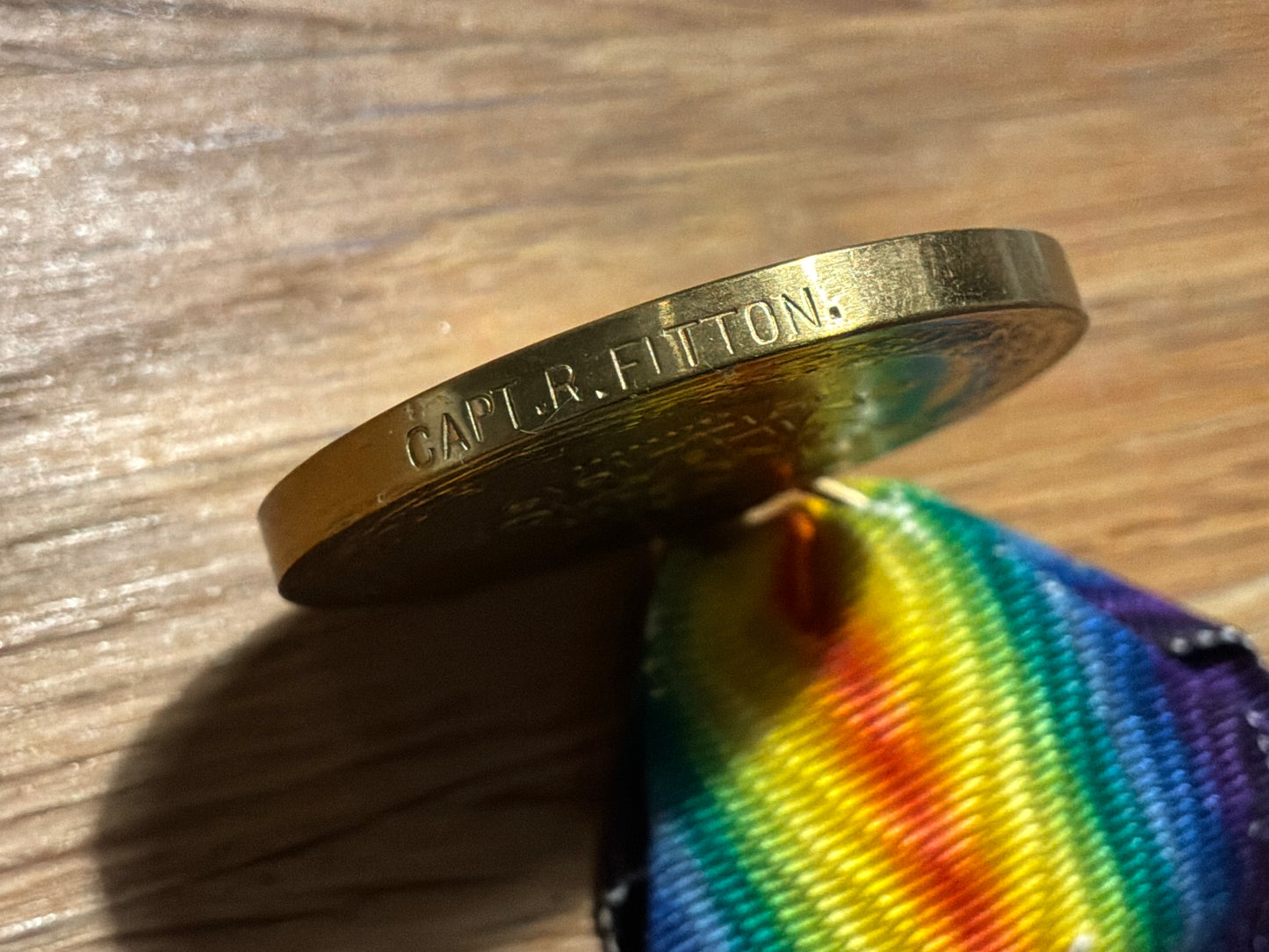
WW1 Victory medal; Capt R.FITTON, K.R.R.C. Boer War veteran.
WW1 Victory medal; Capt R.FITTON, K.R.R.C. Boer War veteran.
SKU:
Couldn't load pickup availability
The life of Richard Fitton, King's Royal Rifle Corps
Mint condition single Victory medal awarded to career soldier Capt Richard FITTON K.R.R.C.
Richard Fitton was a coal miner's son from a Lancashire pit village who joined the King's Royal Rifle Corps as a rifleman and left it as a captain. Along the way he was wounded in the opening weeks of the Boer War, fought to relieve Ladysmith, and was commissioned from the ranks in the first winter of the Great War.
A pit village boy
In April 1881 the census shows him at 68 Kirkless Street in Aspull, a mining village just outside Wigan.
The father, also called Richard, was a coal miner born in Wigan. His wife, Sarah Henrietta, came from neighbouring Haigh.
A rifleman in South Africa
Richard enlisted in the King's Royal Rifle Corps and was given the regimental number 254. By the autumn of 1899 he was a lance-corporal in the 1st Battalion, stationed in Natal when the Boer War broke out.
The battalion was in action almost at once. His medal roll shows the clasp for Talana, the first battle of the war, fought on 20 October 1899. Ten days later, on 30 October, Richard was wounded at Farquhar's Farm, about 10 km east of Ladysmith. That day's fighting, also known as the Battle of Ladysmith or Lombards Kop, went badly for the British and ended with the town under siege.
His clasps tell an unusual story. Most of the men listed around him on the roll have the Defence of Ladysmith clasp, meaning they spent the siege trapped inside the town. Richard does not. Instead he has Tugela Heights and Relief of Ladysmith. This suggests that after being wounded he got out before the town was cut off, recovered, and then fought his way back with the force sent to rescue his own battalion.
He kept fighting through 1900, at Laing's Nek, Belfast, and across Cape Colony and the Orange Free State. By the time the roll was signed in Cape Colony in August 1901, he had been promoted to corporal.
He stayed to the end of the war. The roll for the King's South Africa Medal, signed in Malta in December 1902, lists him as a sergeant. The remarks beside his name appear to read "Home’
From the ranks to a commission
Richard stayed with the regiment for another twelve years and rose to colour-sergeant, one of the senior NCOs of a company. His medal card also records him as a company quartermaster sergeant.
When war came in 1914, the army urgently needed experienced officers. The London Gazette of 14 December 1914 lists Colour-Sergeant Richard Fitton of the King's Royal Rifle Corps among the regular NCOs made second lieutenants, dated 15 December 1914. Five days later, on 20 December 1914, he landed in France.
He was promoted lieutenant with effect from 14 March 1916, as published in the London Gazette of 2 August 1916. He went on to reach the rank of captain, recorded on his medal card, and later described himself as a retired captain of the 3rd Battalion.
After the war
In February 1920 his medal correspondence was sent to Clear View, Gorey, Jersey, in the Channel Islands. In the winter of 1922 he married Ruth Punnett in London. She was born on 27 July 1891, making her 16 years his junior.
By 1939 the couple were running a grocery business at Milton House, in the Lymington registration district of Hampshire. The 1939 Register lists Richard, born 16 August 1875, as a master grocer, with the note "Capt. Ret'd 3rd Batt. K.R.R.C." Ruth is recorded as doing household and grocery business duties.
Richard Fitton died in Bromley in July 1950, aged 74. He had gone from a coal miner's son in a Lancashire pit village to a Boer War veteran, a commissioned officer of the Great War and, finally, a village grocer.
His medals
Richard earned five campaign medals across two wars. Only his Victory Medal survives in this collection.
Share