1
/
of
2
Gradia Militaria
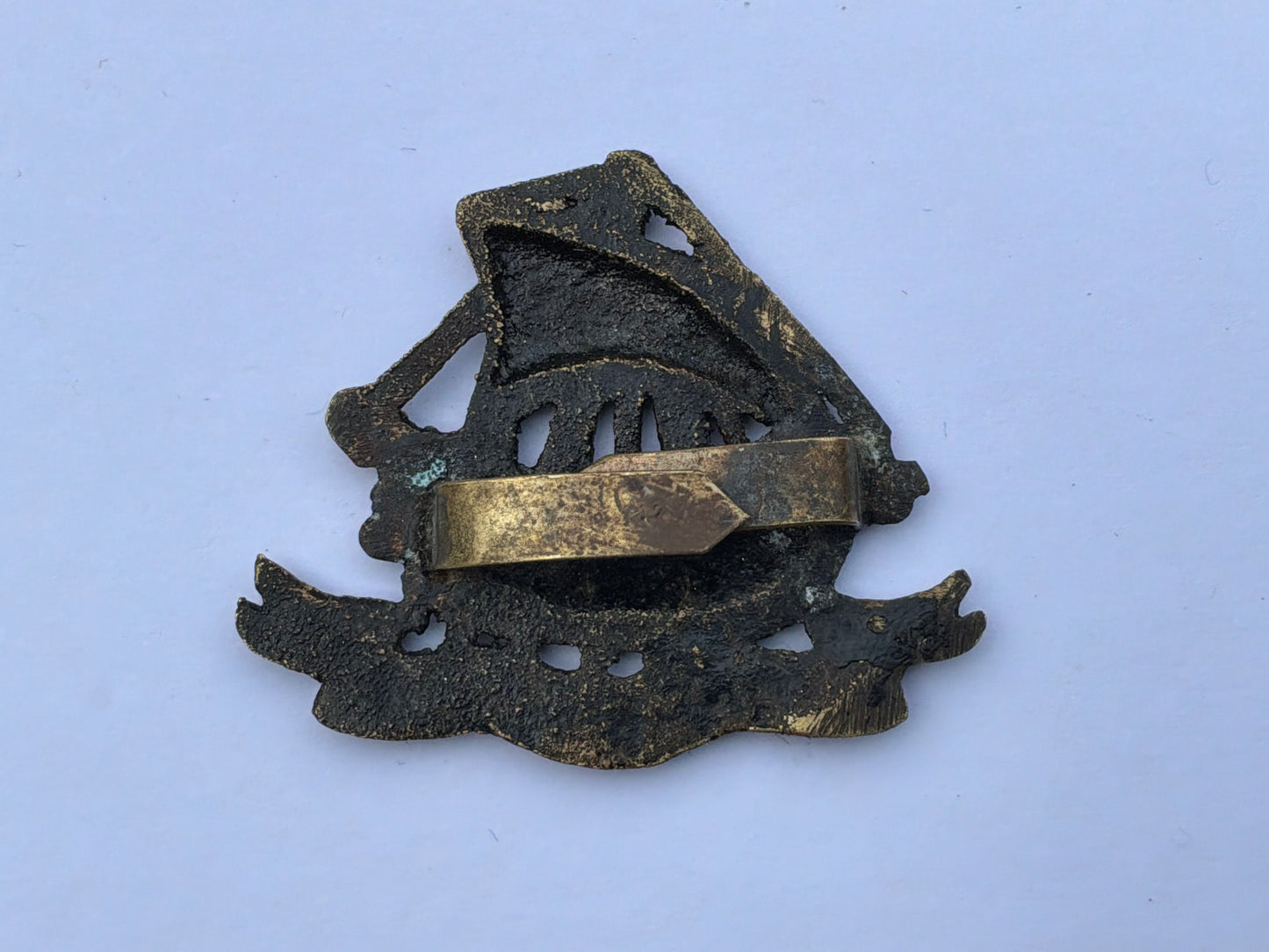
WW2 2ND PUNJAB REGT theatre made OSD cap badge.
WW2 2ND PUNJAB REGT theatre made OSD cap badge.
SKU:20277
Regular price
£40.00
Regular price
Sale price
£40.00
Unit price
/
per
Couldn't load pickup availability
The badge
- Officer's service dress (OSD) cap badge with two rear blade fixings.
- Sand-cast and blackened, made locally in theatre rather than by a UK maker, typical of wartime Indian production.
- The design is a galley with oars and sail above a scroll reading "2ND PUNJAB REGT". The regiment's insignia was a galley with a bank of oars and sail, and its motto was Sthal Wa Jal (By land and sea).
- The title dates it firmly to the regiment's life, 1922 to the partition of India in 1947.
Formation, 1922
- Created in 1922 from five existing regiments, with four regular battalions and a training battalion.
- Its training battalion became the 2nd Punjab Regiment Centre in 1940.
Second World War, battalion by battalion
East Africa 1940 to 1941
- 1st Battalion: sent from Aden to reinforce British Somaliland on 7 August 1940 during the Italian invasion.
- 3rd Battalion: served with 29th Indian Infantry Brigade, 5th Indian Division, in Sudan, Eritrea and Ethiopia.
- At Keren the 3/2nd attacked Mount Zeban on the night of 16 to 17 March 1941. It took four enemy guns and held its ground overnight 800 yards from Fort Dologorodoc.
- Naik Ajaib Khan won an immediate IDSM there. He led his section against an Italian machine-gun post, took the gun, and held it against repeated counter-attacks until he was wounded.
- On 5 May 1941 the 3/2nd attacked the Italian stronghold at Amba Alagi. Twelve machine guns pinned it down for most of the day.
Malaya 1941 to 1942
- 5th Battalion: garrisoned Penang from August 1939, preparing to defend the island's southern beaches.
- It fought with 12th Indian Infantry Brigade, which was among the first to meet the Japanese landings and did better than most units in the campaign.
- The campaign ended with the surrender at Singapore in February 1942, and the battalion went into captivity.
Burma 1942 to 1945
- 7th Battalion: in the Battle of the Admin Box, a company boxed in with Sikh troops to protect a field regiment and anti-aircraft gunners at Awlanbyin. The Japanese took the Ngakyedauk Pass on 7 February 1944, and it was reopened on 23 February.
- 3rd Battalion: during the same battle it held Point 161 high on the Mayu Range under 9th Brigade, so the front had no gap.
- It then served with 123rd Indian Infantry Brigade from April 1944 to March 1945. That brigade served under 5th and 14th Indian Divisions in Burma.
- 2nd Battalion: with 51st Indian Infantry Brigade in the Arakan from September 1944 to March 1945.
- 8th Battalion: a war-raised battalion, with 75th Indian Infantry Brigade on the North West Frontier from April 1942 to July 1943.
Italy 1943 to 1945
- 1st Battalion: with 25th Indian Infantry Brigade in Italy, August to September 1944.
Battle honours for the war
Keren, Ad Teclesan, Amba Alagi, Abyssinia 1940 to 41, Central Malaya, Ipoh, Singapore Island, Malaya 1941 to 42, North Africa 1940 to 43, Casa Bettini, Italy 1943 to 45, Buthidaung, Ngakedaung Pass, North Arakan, Imphal, Litan, Kanglatongbi, Tengnoupal, Tonzang, Kennedy Peak, Defence of Meiktila, Pyinmana, Burma 1942 to 45.
Partition, 1947
- The 1st Punjab Regiment went to Pakistan because it was mainly Muslim, and the 2nd Punjab Regiment went to India.
- In September 1947, Pakistani personnel came from the 2nd Punjab Regimental Centre at Meerut to the 1st Punjab Centre at Jhelum.
- The regiment became the Indian Army's Punjab Regiment and kept the galley badge.
Share